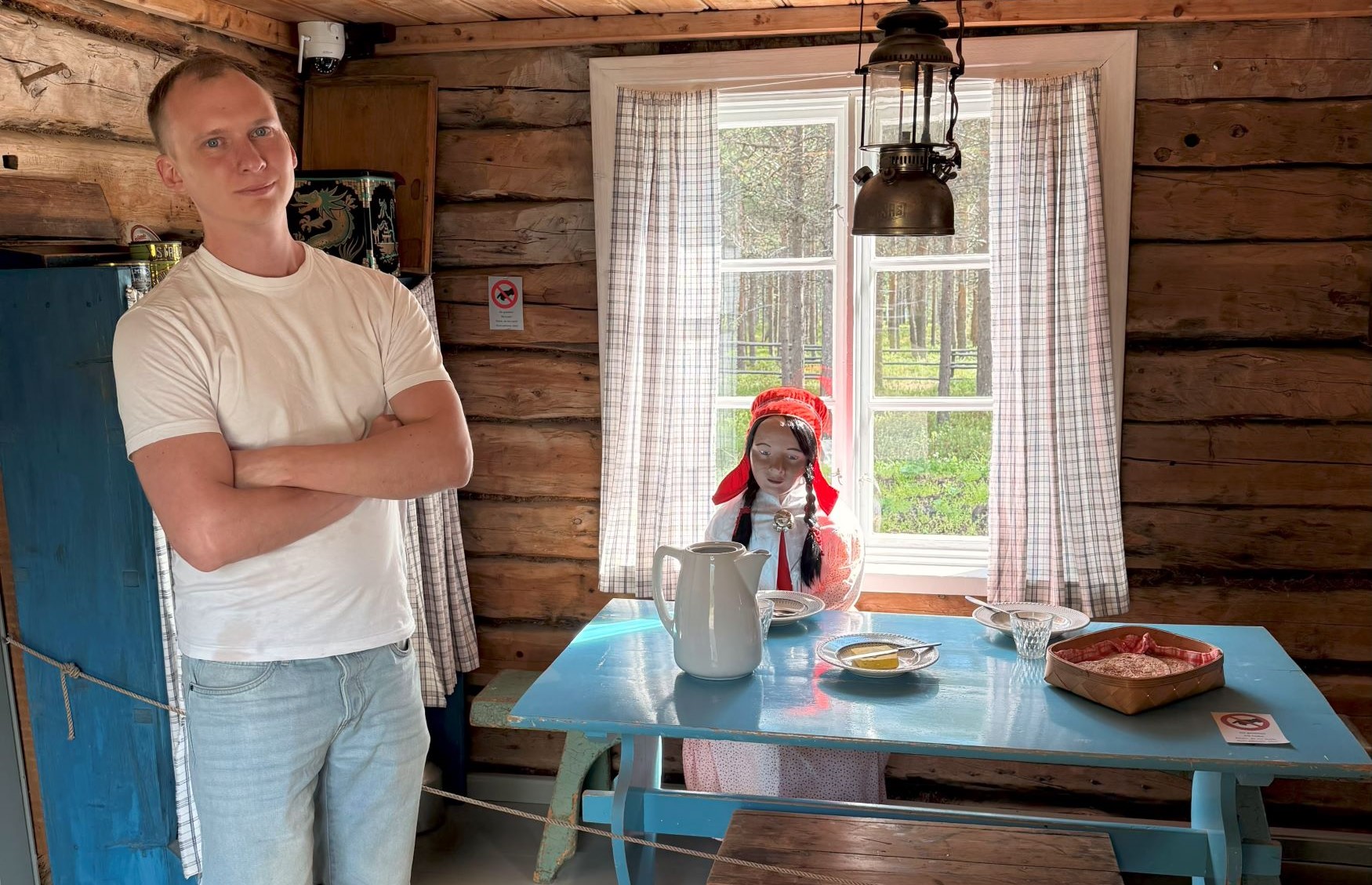
Photo: Inna Getman
Yaroslav Getman tells us about his research on self-supervised learning (SSL) for low-resource languages. Access to LUMI and Roihu supercomputers has played a crucial role in developing speech foundation models for Finnish and Northern Sámi.
I am a doctoral researcher in the Automatic Speech Recognition group at Aalto University. Before my doctoral studies, I completed a bachelor’s degree in Electrical Engineering and a master’s degree in Signal, Speech and Language Processing, also at Aalto.
My research focuses on self-supervised learning (SSL) for underrepresented languages. Most studies focus on English and other high-resource languages, while less-resourced ones lag behind in speech technology. During my PhD, I have contributed to addressing this gap for two languages, Finnish and Northern Sámi.
At a high level, my work has spanned three directions: adapting SSL models in low-resource settings, developing foundation models for underrepresented languages, and interpreting what these models learn internally.
I started my PhD in the DigiTala project, which later continued as DTA, and in Teflon. In these projects, I worked on speech recognition and pronunciation assessment for speaker groups that lack large annotated corpora, such as child speakers and second-language learners. In Teflon, we also organized the Non-native Children’s Automatic Speech Assessment Challenge (NOCASA), held as part of the IEEE MLSP 2025 conference, for which I prepared the baseline systems.
Later on, I joined the LAREINA project, where I focused on developing open-source language-specific speech foundation models. Large-scale corpora are quite rare for underrepresented languages. One option is to leverage sources that were originally intended for other purposes rather than training speech models, and extract and filter usable speech from them. I have been working with the radio and television broadcast archives maintained by KAVI (nowadays merged with the Arts Promotion Centre Finland into the Finnish Arts and Culture Agency KUVI), which have been recorded on a 24/7 basis since 2009 and amount to millions of hours of audio.
For Northern Sámi, I have developed the first publicly available self-supervised speech foundation models trained from scratch. For Finnish, the most recent models were trained on nearly half a million hours of filtered broadcast speech, a scale more typical of English models and industrial efforts.
Access to high-performance computing has played a crucial role in my PhD research. I have had the opportunity to work in two extreme-scale projects (FinW2V2 and FinSAM) on the LUMI supercomputer, and in the pilot project of Roihu, the new Finnish national supercomputer.
My research has also focused on exploring what these foundation models learn internally. I have studied how different pretraining strategies shape the resulting acoustic representations and how much of a model’s capacity is actually used for speech recognition.
Self-supervised speech foundation models are pretrained on large amounts of unlabeled speech, but they still require annotated data to perform speech recognition and other speech tasks. In my experiments, I have used the Finnish Parliament and the Lahjoita puhetta (Donate Speech) corpora extensively. Besides using data resources available in Kielipankki, I have also contributed to preparing the DigiTala second-language learner speech corpus for release there.
Getman, Y., Grósz, T., Lehtonen, T., Kurimo, M. (2026) Data filtering trade-offs in self-supervised speech representation learning: a study on unconstrained broadcast audio. Proc. Interspeech 2026, 4427-4432, doi: 10.21437/Interspeech.2026-50
Getman, Y., Grósz, T., Kurimo, M. (2026) Do learned layer weights reflect pretrained information structure in self-supervised speech models?. Proc. Interspeech 2026, 6032-6036, doi: 10.21437/Interspeech.2026-566
Getman, Y., Grósz, T., Lehtonen, T., Kurimo, M. (2025) Is your model big enough? Training and interpreting large-scale monolingual speech foundation models. Proc. Interspeech 2025, 231-235, doi: 10.21437/Interspeech.2025-46
Getman, Y., Grósz, T., Hiovain-Asikainen, K., Lehtonen, T., Kurimo, M. (2025) Towards large-scale speech foundation models for a low-resource minority language. Proc. NoDaLiDa/Baltic-HLT 2025, 192-200
Getman, Y., Grósz, T., Kurimo, M., Salvi, G. (2025) Non-Native Children’s Automatic Speech Assessment Challenge (NOCASA). Proc. IEEE MLSP 2025, 1-6, doi: 10.1109/MLSP62443.2025.11204209
The FIN-CLARIN consortium consists of a group of Finnish universities along with CSC – IT Center for Science and the Institute for the Languages of Finland (Kotus). FIN-CLARIN helps the researchers of Social Sciences and Humanities to use, refine, preserve and share their language resources. The Language Bank of Finland is the collection of services that provides the language materials and tools for the research community.
All previously published Language Bank researcher interviews are stored in the Researcher of the Month archive. This article is also published on the website of the Faculty of Humanities of the University of Helsinki.
Photo: Marjo-Leea Alapuranen
Sanna Nordlund tells us about her research on Finnish Sign Language. Her work explores topics such as agent defocusing, the use of signing space, and referentiality. Annotated corpora provide valuable resources for investigating these phenomena and the linguistic structure of signs.
I am Sanna Nordlund, a doctoral researcher at the Sign Language Centre at the University of Jyväskylä. My research focuses on the structure of Finnish Sign Language from a corpus-based perspective. I am currently funded by a grant from the Finnish Cultural Foundation and have previously received a multi-year grant from the Kone Foundation. My previous experience includes serving as a substitute lecturer in the Sign Language Interpreter programme at Humak University of Applied Sciences (2023–2024) and working on the Corpus and SignWiki project at the Finnish Association of the Deaf (2013–2015). Prior to pursuing an academic career, I also worked as a sign language interpreter.
As a sign language researcher, I draw on and combine the knowledge and skills I acquired through my studies in general linguistics with the expertise I gained through my education and professional experience as a sign language interpreter. I also serve as one of the group leaders of the Sign Languages and Deaf Studies thematic group within the Langnet doctoral network.
In my doctoral research, I investigate agent defocufing, the use of signing space, and referentiality in Finnish Sign Language. In my first article, published in 2019, I examined the different ways in which the semantic role of agent can be defocused in Finnish Sign Language. The study identified several strategies for agent defocusing but found no evidence of a dedicated morphological passive.
My second article, published in the summer of 2026, analyzed the various functions of the pointing sign directed at the signer. Besides referring to the signer, such pointing serves a remarkably wide range of other functions. The manuscript of my third study is currently in preparation. In this work, I investigate how signing space and the signer’s body are used in the modification of so-called directional verbs.
My corpus-based research provides new evidence on structures that have received little or no previous scholarly attention and that have often been described primarily on the basis of intuition rather than language use. It also challenges and refines certain assumptions currently prevailing in sign language teaching.
The data for my doctoral research has gradually expanded alongside the development of corpus work on Finnish Sign Language. My first article (2019) is based on my Master’s thesis (Ala-Sippola 2012), completed at a time when a corpus of Finnish Sign Language was still only an aspiration. The study was based on approximately 11.5 minutes of signed material from the Finnish Sign Language version of the Language Policy Programme for the National Sign Languages in Finland. This material was later annotated and published in the Language Bank of Finland as the Kipo Corpus (2015). The Kipo Corpus was developed at the Finnish Association of the Deaf as part of the Corpus and SignWiki project, in which I worked between 2013 and 2015. During the project, we developed the first annotation conventions for Finnish Sign Language.
In my second article (2026), the data consists of the entire Kipo Corpus as well as three elicitation tasks from eight signers from the Corpus of Finnish Sign Language (CFINSL), published in 2019. The dataset includes recordings from 12 different signers and comprises a total of 4 hours and 55 minutes of video data. In my third article, I also use data from a corpus release published in 2024. In addition to the Kipo Corpus, the dataset includes CFINSL data from four elicitation tasks, bringing the total number of signers represented in the material to 28. To the best of my knowledge, this is the largest and most diverse corpus dataset used in research on Finnish Sign Language to date.
Although the detailed analyses are based on a corpus sample, the most frequent directional verbs were identified from all Finnish Sign Language corpus data that has been published in the Language Bank of Finland and annotated with ID glosses (CFINSL Parts 1 and 2 and the Kipo Corpus). The annotated corpus data amounts to approximately 26 hours. It is encouraging that research on Finnish Sign Language can increasingly rely on larger and more comprehensive datasets. Corpus data make it possible to identify linguistic features and phenomena that may remain unnoticed in studies based solely on language users’ intuitions.
Nordlund, Sanna. (2026). Uses of the pointing sign directed at the signer in Finnish Sign Language. Sign Language and Linguistics, Online First. https://doi.org/10.1075/sll.24009.nor.
Nordlund, S. (2019). Agent defocusing in two-participant clauses in Finnish Sign Language. Glossa: a journal of general linguistics 4(1), 82. http://doi.org/10.5334/gjgl.801
Ala-Sippola, Sanna. 2012. Agentin ilmaiseminen suomalaisella viittomakielellä tuotetussa asiatekstissä. Helsinki: Helsingin ylipisto, Pro gradu -tutkielma. [julkaisematon]
The FIN-CLARIN consortium consists of a group of Finnish universities along with CSC – IT Center for Science and the Institute for the Languages of Finland (Kotus). FIN-CLARIN helps the researchers of Social Sciences and Humanities to use, refine, preserve and share their language resources. The Language Bank of Finland is the collection of services that provides the language materials and tools for the research community.
All previously published Language Bank researcher interviews are stored in the Researcher of the Month archive. This article is also published on the website of the Faculty of Humanities of the University of Helsinki.
Photo: Rodolfo Basile
Rodolfo Basile tells us about his research on constructions that express locative and existential meanings in Finnish and other Finnic languages. Resources from the Language Bank of Finland have played a role in all of his research articles on Finnish.
I am an Italian linguist whose career began with the Finnish language. At the University of Naples ”L’Orientale”, I studied Finnish Language and Literature as my main subject at both bachelor’s and master’s level. I also studied German as a minor and improved my Swedish language skills during an Erasmus exchange at the University of Helsinki. In Helsinki, I worked as a teaching assistant in Italian and Finnish language courses. After completing my master’s degree, I joined FILI (Finnish Literature Exchange) in Helsinki as a trainee through the Finnish in Finland training programme funded by the Finnish National Agency for Education.
In 2024, I completed my PhD in Finnic Languages jointly at the Universities of Tartu and Turku under a cotutelle agreement. During my doctoral studies, I also taught Finnish. After earning my PhD, I moved to Kyoto, Japan, to work as a postdoctoral researcher.
In my doctoral dissertation, I investigated a group of morphosyntactic constructions that I refer to as invenitive constructions in Finnish. Using both quantitative and qualitative methods, I examined these structures within the context of European languages. Invenitive constructions express locative and existential meanings through the use of the Finnish verb löytyä (‘to be found’), which replaces the copula olla (‘to be’). Comparable functions are expressed in other European languages through similar verbal strategies.
Since completing my doctoral dissertation, I have continued my research on invenitive constructions in Estonian, comparing them with their Finnish counterparts, while focusing on a variety of other research areas. For example, I have been working on voice and valency in Finnish and Italian as well as causative constructions. I have also been conducting research on the typology of locational and possessive clauses in Livonian, which is currently awaiting publication. At present, I am finishing up a similar project on the Koman languages spoken in the border region between Sudan and Ethiopia, in collaboration with an Ethiopian colleague.
My current research interests include the expression of locational meaning through transitive verbs from a pragmatic-typological perspective, the study of two-place verbs, and the comparative documentation of several Austronesian languages, including Toba Batak, Manggarai, and Uab Meto (aka Dawan), using data elicited from grammatical questionnaires.
The resources available through the Language Bank are easy to use, and I have relied on them in all of my research articles on Finnish. The Finnish texts in the Newspaper and Periodical Corpus of the National Library of Finland (KLK) were the first dataset I learned to work with, and they enabled me to publish the first research article of my career.
The Suomi24 corpus has been particularly useful, as it provides a large amount of data and makes it possible to investigate a wide range of grammatical phenomena through the language used by ordinary people in everyday communication. It also allows researchers to examine linguistic variation in depth, revealing even rare patterns of language use.
Basile, Rodolfo. 2025a. Invenitive-locational constructions in the languages of Europe. In Däbritz, Chris Lasse, Budzisch, Josefina & Basile, Rodolfo (eds.). Locative and existential predication: On forms, functions and neighboring domains, 367–402. Berlin: Science Press. https://doi.org/10.5281/zenodo.16759903
Basile, Rodolfo. 2025b. Dal finlandese all’estone: considerazioni tipologiche e cenni diacronici sulle costruzioni invenitive. Studi Finno-Ugrici, n.S., 5. https://doi.org/10.6093/1826-753X/13042
Basile, Rodolfo. 2025c. The Finnish Existential Partitive Construction: Comparing Two Applications of Collostructional Analysis. In Leuschner, T., Vajnovszki, A., Delaby, G. & Barðdal, J. (eds.) How to Do Things with Corpora: Methodological Issues and Case Studies on Grammar, 67–89. Berlin, Heidelberg: Springer. https://doi.org/10.1007/978-3-662-69690-3_4
Basile, Rodolfo. 2024. ‘I am also found on Facebook’: Locuphoric ‘Find’-Based Strategies in Finnish Internet Corpora. In Glaser, E., Sleeman, P., Strobel, T., & Tamm, A. (eds.). Partitive Constructions and Partitive Elements Within and Across Language Borders in Europe (Vol. 3). Edizioni Ca’Foscari-Venice University Press. http://doi.org/10.30687/978-88-6969-795-1/007
Basile, Rodolfo & Ivaska, Ilmari. 2021. Löytyä-verbin konstruktioiden yhteydessä esiintyvä subjektin sijanvaihtelu. Eesti ja soome-ugri keeleteaduse ajakiri. Journal of Estonian and Finno-Ugric Linguistics, 12(1), 11-39. https://doi.org/10.12697/jeful.2021.12.1.01
The FIN-CLARIN consortium consists of a group of Finnish universities along with CSC – IT Center for Science and the Institute for the Languages of Finland (Kotus). FIN-CLARIN helps the researchers of Social Sciences and Humanities to use, refine, preserve and share their language resources. The Language Bank of Finland is the collection of services that provides the language materials and tools for the research community.
All previously published Language Bank researcher interviews are stored in the Researcher of the Month archive. This article is also published on the website of the Faculty of Humanities of the University of Helsinki.
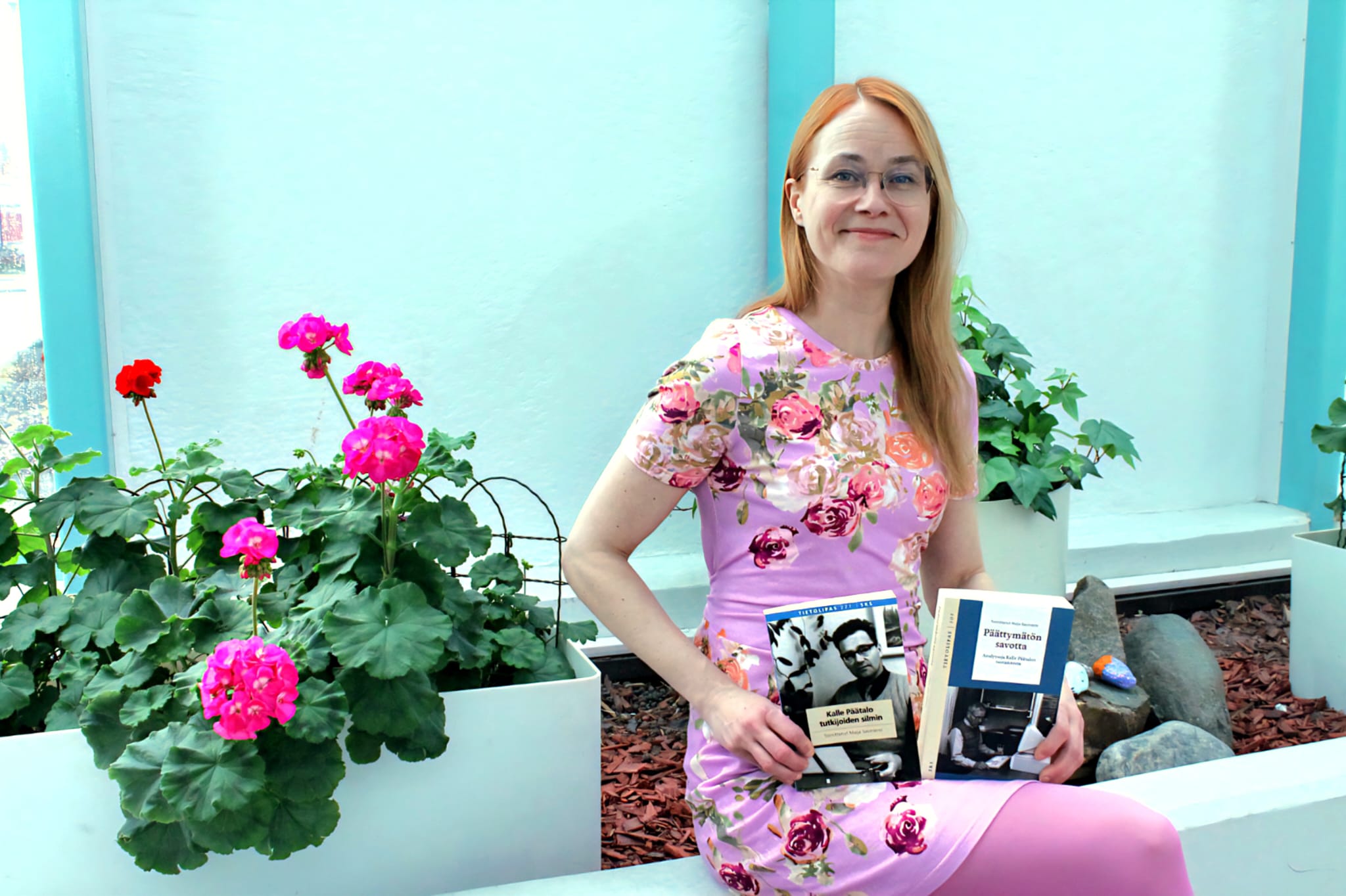
Photo: Maija Saviniemi
Minna Sääskilahti tells us about her research on Kalle Päätalo’s Iijoki series. With the help of the Korp tool, locating relevant text passages has been straightforward, especially when working with the entire 26-volume series.
I am Minna Sääskilahti and I work as a university lecturer of Finnish language and literature education at the University of Oulu. I graduated as teacher of Finnish language and literature in 2000 and earned my PhD in 2006 from the University of Oulu. My doctoral dissertation examined the genre of alcohol education and its changes between the years 1755 and 2001.
In my current position, my research focuses on Finnish language and literature education. I have examined, for example, students’ views on the importance of literacy skills, as well as media discussions on young people’s literacy. Questions related to literacy have also been central to my research on the Iijoki series by Kalle Päätalo, in which I have primarily employed discourse analysis. In my first research article on the Iijoki series (2022), I examine discourses of writing. In a subsequent co-authored article (2023), we analyze discourses of reading. My most recent article focuses on discourses and representations of skiing in the Iijoki series.
The Language Bank of Finland has been involved in my research on the Iijoki series, as I have made use of the Iijoki corpus from the University of Oulu Päätalo Collection. The corpus contains all 26 novels in the Iijoki series, which has made it an essential tool for my research. As I use discourse analysis as my research method, it has been important to read and analyze the research data very thoroughly. The corpus has helped me identify relevant passages across the entire series. This has been useful in all of my articles, but especially in my most recent one on the discourses of skiing, where my data consisted of the entire Iijoki series.
I have used the search functions and carefully selected keywords to investigate how extensively Päätalo adresses themes such as writing, reading, and skiing in the series. The search results have helped me identify passages in which the phenomenona under study are described in sufficient depth. For example, although skiing is mentioned in all the novels in the series, not every novel contains detailed descriptions or extended narratives of skiing. In the works I selected as my research data, descriptions of skiing can extend to dozens of pages. Even though I have used the printed novels as my primary research data, I would not have been able to conduct my research without the Iijoki corpus from the University of Oulu Päätalo Collection.
I will likely continue to use this corpus in my future research. Päätalo provides highly nuanced descriptions of the physical and social milieu of the Iijoki series, which makes his work a rich source for a wide range of research topics. As a teacher educator, I am particularly interested in the series’ representations of social inequality related to schooling.
Sääskilahti, Minna 2026: Elämänpiiri laajenee hiihtämällä. Hiihtämisen diskurssit Kalle Päätalon Iijoki-sarjassa. – Maija Saviniemi (toim.), Päättymätön savotta. Analyyseja Kalle Päätalon tuotannosta. 276—298. Helsinki: SKS. DOI: https://doi.org/10.21435/tl.305
Sääskilahti, Minna, Mantila, Harri & Saviniemi, Maija 2023: Lukemisen diskurssit Kalle Päätalon Iijoki-sarjassa. – Pirjo Hiidenmaa, Ilona Lindh, Sara Sintonen & Roosa Suomalainen (toim.), Lukemisen kulttuurit. 238—251. Helsinki: Gaudeamus.
Sääskilahti, Minna 2022: ”Ja eikähän sulle tuu minkäällaista käsiallaa” – kirjoittamiskäsitykset Kalle Päätalon Iijoki-sarjassa. – Maija Saviniemi (toim.), Kalle Päätalo tutkijoiden silmin. 131—152. Helsinki: SKS. https://doi.org/10.21435/tl.271
The FIN-CLARIN consortium consists of a group of Finnish universities along with CSC – IT Center for Science and the Institute for the Languages of Finland (Kotus). FIN-CLARIN helps the researchers of Social Sciences and Humanities to use, refine, preserve and share their language resources. The Language Bank of Finland is the collection of services that provides the language materials and tools for the research community.
All previously published Language Bank researcher interviews are stored in the Researcher of the Month archive. This article is also published on the website of the Faculty of Humanities of the University of Helsinki.
Photo: Niko Jouhkimainen
Milla Uusitupa tells us about her research on the clause structures of Finnish and Karelian dialects and on how these structures are used in interaction.
I am a researcher of Finnish and Karelian at the University of Eastern Finland, where I also work as a university lecturer in Finnish. In addition to research, my work involves advising new students and, in particular, teaching various aspects of grammar, research skills, and bachelor’s theses. I enjoy these both side of my job: it is rewarding to delve into questions that I personally find interesting, and equally enjoyable to work with students at different stages of their studies.
My research focuses on the clause structures of Finnish and Karelian dialects and on how these structures are used in interaction. I usually describe my work as interactional linguistic research on dialect syntax. In addition to grammatical research, I have studied historical multilingualism together with Vesa Koivisto, examining what the linguistic landscape looked and sounded like a hundred years ago in Border Karelia, a region north of Lake Ladoga that was then part of Finland. At present, I am also working on a manuscript related to research history, in which I explore the early stages of dialect syntax in the final decades of the nineteenth century.
I have worked with many of the corpora currently available in the Language Bank, as well as with corpora that are still forthcoming. The corpus I am most familiar with – and in many ways closest to my heart – is the Corpus of Border Karelia, which contains approximately 120 hours of interviews with Karelian-speaking evacuees recorded in the 1960s and 1970s. I first encountered this corpus while writing my master’s thesis and have continued to use it actively ever since. What fascinates me about the Corpus of Border Karelia is not only the language itself, but also the topics discussed in the interviews and the world they depict. Using this material, I have studied both the meaning and use of grammatical structures (such as the zero person, the open second-person singular, and the unipersonal passive), as well as the historical multilingualism of the Border Karelia region. Traditionally, both Karelian and Finnish were spoken in this area, and its inhabitants also maintained diverse connections with Karelians living east of the border, as well as with the Russian and Church Slavonic languages through the Orthodox Church. After Finland gained independence, this situation changed, and the influence of Finnish increased, particularly with the expansion of the Finnish public school system.
From the Karelian-language corpora in the Language Bank, I have also used the Corpus of Tver Karelian (1957–1971) in my research on Karelian modal verbs. Among the Finnish-language corpora, I am most familiar with the dialect corpora, such as the Samples of Spoken Finnish and the Follow-up Study of Dialects of Finnish. Together with Hannele Forsberg, I have used these materials to examine the open use of the second-person singular and the action sequences used to express opinions in dialect interviews.
My research questions require familiarity with a broader conversational context, and for this reason I have listened to the interviews in these corpora in their entirety, from beginning to end. This approach is time-consuming, but it makes it possible to observe not only individual forms and structures, but also what is accomplished with them in the interview situation and how the interaction between interviewer and interviewee is constructed. Even in older materials, there is still a great deal to be explored from this perspective, which takes into account the social dimensions of language use. Together with Hannele Forsberg and Maria Vilkuna, I have recently written about the electronic dialect corpora of the Language Bank in the introductory review article of the volume Sanovat syntaksiksi (’They call it syntax’).
Through my teaching work and various student assignments, I have also learned to some extent how to use other corpora in the Language Bank. For example, students often turn to the Suomi24 corpus when they begin exploring the usage of a particular word or structure. The old saying that one learns best by teaching certainly holds true.
Forsberg, Hannele – Uusitupa, Milla 2025: Murretallenteet affektisen konstruktion tutkimusaineistona. Avoin yksikön 2. persoona kantaa ottavissa toimintajaksoissa. – Milla Uusitupa, Hannele Forsberg & Maria Vilkuna (eds.), Sanovat syntaksiksi. Aineistopohjaisia tutkimuksia murteiden lauseopista pp. 461–523. SKST 1505. Helsinki: SKS. https://doi.org/10.21435/skst.1505.
Forsberg, Hannele – Uusitupa, Milla – Vilkuna, Maria 2025: Murresyntaksin tutkimusta ja aineistoja muistiinpanoista sähköisiin korpuksiin. – Milla Uusitupa, Hannele Forsberg & Maria Vilkuna (eds.), Sanovat syntaksiksi. Aineistopohjaisia tutkimuksia murteiden lauseopista pp. 22–112. SKST 1505. Helsinki: SKS. https://doi.org/10.21435/skst.1505.
Uusitupa, Milla 2021: Subjektin merkintä tverinkarjalan pidiä-, šuaha– ja voija-konstruktioissa. – Suomalais-Ugrilaisen Seuran Aikakauskirja 98 pp. 399–436. https://doi.org/10.33340/susa.95404.
Uusitupa, Milla 2021: Passiivilauseiden merkitys ja käyttö yhdellä ilomantsilaispuhujalla. – Sananjalka 63 pp. 55–78. https://doi.org/10.30673/sja.107331.
Uusitupa, Milla – Koivisto, Vesa 2020: Monikielinen Raja-Karjala. – Leena Kolehmainen, Helka Riionheimo & Milla Uusitupa (eds.), Ääniä idästä. Näkökulmia Itä-Suomen monikielisyyteen pp. 143–190. SKST 1461. Helsinki: SKS.
Uusitupa, Milla 2017: Rajakarjalaismurteiden avoimet persoonaviittaukset. Dissertations in Education, Humanities, and Theology 117. Joensuu: Itä-Suomen yliopisto. http://urn.fi/URN:ISBN:978-952-61-2646-3.
The FIN-CLARIN consortium consists of a group of Finnish universities along with CSC – IT Center for Science and the Institute for the Languages of Finland (Kotus). FIN-CLARIN helps the researchers of Social Sciences and Humanities to use, refine, preserve and share their language resources. The Language Bank of Finland is the collection of services that provides the language materials and tools for the research community.
All previously published Language Bank researcher interviews are stored in the Researcher of the Month archive. This article is also published on the website of the Faculty of Humanities of the University of Helsinki.
Photo: Thomas Bürgisser
Max Wahlström tells us about his research on the Suomi24 corpus. Because of its large size, the corpus enables the analysis of many different phenomena, but it also calls for caution in interpreting what the language represented in the data can tell us.
I am a Slavist and a linguist. Through my research, the region I know best is the Balkans. I am a senior university lecturer in the Faculty of Humanities at the University of Helsinki, where I teach Bosnian, Croatian, Montenegrin and Serbian, as well as a wide range of courses, mainly in linguistics and Slavic studies.
My research spans a wide range of topics, which can make it difficult to define a single unifying theme. When funding applications require one, I usually describe my interests as focusing on phenomena related to argument marking, referentiality and information structure, as well as their variation and diffusion through language contact. What fascinates me about language as an object of study is its emergence from human activity and interaction, and the regularities that arise from this process – regularities that speakers are often unaware of unless the rules are broken. It is precisely when rules are bent or stretched that particularly interesting phenomena emerge. When a new construction gains ground, a loanword spreads, or an expression becomes metaphorical, language appears at its most intriguing: a constantly changing and adaptive object.
The resources of the Language Bank allow me to study phenomena that are either too rare to be observed in smaller datasets or whose variation is shaped by complex factors such as linguistic context, genre or historical period. Because of its size, I have primarily used the Suomi24 corpus. Without it, the phenomena analysed in my article on social media “likes” could not have been investigated. At the same time, there are no free lunches: together with my colleagues, I examine the conditions under which Suomi24 can be considered a corpus in the same sense as many other resources in the Language Bank. Our work also shows that the topic of discussion has a major impact on how colloquial or standard the language in Suomi24 discussions is.
Niva, Heidi, Olli O. Silvennoinen & Max Wahlström. 2025. Mitä tutkimme, kun käytämme Suomi24-korpusta? Verkkokeskustelukorpus suomen edustajana. Virittäjä 129(4). 487–517. https://doi.org/10.23982/vir.163133.
Wahlström, Max. 2025. The “like” button and Finnish transitivity. Finnish Journal of Linguistics 38. 211–222. https://doi.org/10.61197/fjl.145021.
Makartsev, Maxim, Max Wahlström & Anastasia Escher. 2024. Lability in Balkan Slavic. Studies in Language. 1–28. https://doi.org/10.1075/sl.23062.mak.
Gijn, Rik van & Max Wahlström. 2023. Linguistic areas. Teoksessa Rik van Gijn, Hanna Ruch, Max Wahlström & Anja Hasse (eds.), Language contact: Bridging the gap between individual interactions and areal patterns, 179–219. Berlin: Language Science Press. https://doi.org/10.5281/zenodo.8269244.
Wahlström, Max & Jouko Sakari Lindstedt. 2020. Kielikontaktien tutkimus. Teoksessa Milla Luodonpää-Manni, Markus Hamunen, Reetta Konstenius, Matti Miestamo, Urpo Nikanne & Kaius Sinnemäki (eds.), Kielentutkimuksen menetelmiä I-IV (Suomalaisen Kirjallisuuden Seuran Toimituksia), 557–595. Helsinki: Suomalaisen Kirjallisuuden Seura. https://doi.org/10.21435/skst.1457.
The FIN-CLARIN consortium consists of a group of Finnish universities along with CSC – IT Center for Science and the Institute for the Languages of Finland (Kotus). FIN-CLARIN helps the researchers of Social Sciences and Humanities to use, refine, preserve and share their language resources. The Language Bank of Finland is the collection of services that provides the language materials and tools for the research community.
All previously published Language Bank researcher interviews are stored in the Researcher of the Month archive. This article is also published on the website of the Faculty of Humanities of the University of Helsinki.
Photo: Aku-Matti Valkama
Heini Kallio tells us about her research on the phonetics of language learning, speech intelligibility and the automatic assessment of oral skills in a foreign language.
I am a university lecturer in phonetics at Tampere University, where I have worked since 2023. I defended my doctoral thesis in 2022 at the University of Helsinki, where I was part of the Phonetics and Speech Synthesis research group. I have been a visiting researcher at the Slovak Academy of Sciences and the University of Nitra, and I have contributed to several research projects related to language learning and language proficiency assessment. My academic background includes a major in phonetics as well as a broad range of studies in communication, psychology, languages, and speech sciences.
An endless source of inspiration in my research is the difficulty and ease of speaking in second and foreign languages. I explore how the acoustically measurable features of speech relate to people’s evaluations of a language learner’s proficiency or, for example, their experience of the speaker’s intelligibility. In the DigiTala project, I examined the Swedish spoken by Finnish high school students and the Finnish spoken by immigrants, with the aim of identifying acoustic parameters that could be used for the automatic assessment of oral language skills. In addition to the DigiTala data, my dissertation material also included English spoken by Czech, Slovak, Polish, and Hungarian learners, which I continued to study after completing my dissertation. Since then, I have also had the opportunity to investigate the prosodic features of Finnish learners of French.
In 2024–2025, I led my first research project, funded by Svenska Kulturfonden, on the pronunciation of Finland-Swedish among beginner learners from different language backgrounds. In the project, we studied the Swedish spoken by immigrants in Finland. We analyzed, among other things, the impact of language background on the acoustic features of Swedish speech and on listeners’ perceptions of beginner learners’ speech.
Before my current position, I worked as a researcher in the DigiTala project funded by the Research Council of Finland. In DigiTala, we developed the first tool for automatically assessing different areas of oral language proficiency in Finnish and Finland-Swedish. The end result of the project was the DigiTala Moodle plugin. This ambitious consortium project brought together experts in language didactics, language and speech technology, and phonetics, many of whom are continuing the work initiated in DigiTala by, for example, developing a mobile application for learners of Finnish (DigiTala in action) and researching the automatic assessment of oral interaction in the AASIS project.
Automatic assessment is based on speech recognition and machine learning models, which perform better the more extensive and relevant the training data is. Therefore, in DigiTala we designed and collected extensive corpora for research and development, including oral language proficiency tasks for learners of Finnish and Swedish, assessment criteria for different areas of oral language proficiency, and comprehensive sets of speech and assessment data. The speech and assessment corpora from DigiTala are available via Kielipankki for scientific research purposes. The oral tasks, assessment criteria, and questionnaires used in the research project can be found on the DigiTala Zenodo community. The speech data collected in DigiTala from learners of Finland-Swedish was also examined in the project “Pronunciation of Finland-Swedish in beginner learners with different native languages”.
Heinonen, H. & Kallio, H. (In press). Realiseringen av begriplighetsrelaterade uttalsdrag i finlandssvenska hos L2 talare från olika språkbakgrund. Svenskan i Finland 21.
Kallio, H. & Kaźmierski, K. (2024). Reduction of unstressed English vowels by EFL speakers with different language backgrounds. In International Symposium on Applied Phonetics (pp. 38 42). International Speech Communication Association (ISCA). doi: 10.21437/ISAPh.2024-8
Kallio, H. (2024). The contribution of speech timing, f0 change, and voice quality to perceived prosodic proficiency in L2: a cross lingual perspective. In Speech prosody (pp. 507 511). International Speech Communication Association (ISCA). doi: 10.21437/SpeechProsody.2024-103
von Zansen, A. & Kallio, H. (2024). DigiTala – Moodle sovellus suullisen kielitaidon automaattiseen arviointiin. (DigiTala – An online tool for automated assessment of oral language skills.) AFinLA teema, 17, pp. 91 116. doi: 10.30660/afinla.131465
Kallio, H., Kautonen.M. & Kuronen, M. (2023). Prosody and fluency of Finland Swedish as a second language: investigating global parameters for automated speaking assessment. Speech Communication, Volume 148, pp. 66 80, 2023. doi: 10.1016/j.specom.2023.02.003
Additional note: Unfortunately, the automatic assessment algorithms developed in the DigiTala project are not in general use due to the universities’ limited server capacity. In other words, the Moodle plugin can currently be used mainly to support oral practice and teacher-led assessment.
The FIN-CLARIN consortium consists of a group of Finnish universities along with CSC – IT Center for Science and the Institute for the Languages of Finland (Kotus). FIN-CLARIN helps the researchers of Social Sciences and Humanities to use, refine, preserve and share their language resources. The Language Bank of Finland is the collection of services that provides the language materials and tools for the research community.
All previously published Language Bank researcher interviews are stored in the Researcher of the Month archive. This article is also published on the website of the Faculty of Humanities of the University of Helsinki.
Photo: Antti Yrjönen
Kielipankki – The Language Bank of Finland offers a comprehensive set of resources, tools and services in a high-performance environment. Kalle Lahtinen tells us about his research on linguistic affect and speech emotion in the context of spontaneous Finnish.
I’m Kalle Lahtinen, a doctoral researcher at the Signal Processing Research Centre at Tampere University. Prior to my postgraduate studies, I studied computer science, signal processing, acoustics, and mathematics. My doctoral thesis is supervised by Professor Okko Räsänen and Senior University Lecturer Liisa Mustanoja from Tampere University, as well as Senior University Lecturer Juraj Šimko from the University of Helsinki.
The topic of my doctoral thesis is Human and Machine Perception of Affect in Speech. I investigate linguistic affect and speech emotion in the context of spontaneous Finnish. By spontaneous, I refer to unacted, unconstrained expression in (everyday) speech. I use both spoken and written language in my work. I examine how the semantic content of speech (what was said) and the corresponding acoustic signal (how it was said) vary, interact, and shape the interpretation of affective expression as a whole.
In my research, I analyze large language corpora using signal processing and machine learning methods. My doctoral thesis produces new data and approaches for analyzing and modeling linguistic affect in a way that considers both individual and situational variation in spoken language. The findings contribute to advances in both linguistic research and the developments of speech technology applications.
My work is part of the interdisciplinary CONVERGENCE of Humans and Machines project at Tampere University, funded by the Jane and Aatos Erkko Foundation.
FinnAffect, a corpus of spontaneous emotional speech in Finnish compiled during the first phase of my doctoral research, will be published in the Language Bank of Finland. The corpus is compiled from the Donate Speech, Helpuhe, and Tampuhe datasets (which are already available or will soon be available through the Language Bank). The FinnAffect corpus consists of 1,474,728 transcribed utterances lasting 1–20 seconds, of which 12,000 have been annotated for emotional valence and arousal. The corpus contains speech from thousands of speakers and is therefore the first of its kind in Finland in the field of linguistic affect research. The compilation and publication of the FinnAffect corpus was made possible by the extensive spoken-language resources already deposited in the Language Bank of Finland and, of course, by the expert support they provided to me there.
Lahtinen, K., Vaaras, E., Mustanoja, L., Räsänen, O. (2025). Investigating affect mining techniques for annotation sample selection in the creation of Finnish affective speech corpus. Interspeech 2025, 3958-3962. DOI: https://doi.org/10.21437/interspeech.2025-687
Lahtinen, K., Mustanoja, L., Räsänen, O. (2025). FinnAffect: An affective speech corpus for spontaneous Finnish. Speech Communication 175, 103327–. DOI: https://doi.org/10.1016/j.specom.2025.103327
The FIN-CLARIN consortium consists of a group of Finnish universities along with CSC – IT Center for Science and the Institute for the Languages of Finland (Kotus). FIN-CLARIN helps the researchers of Social Sciences and Humanities to use, refine, preserve and share their language resources. The Language Bank of Finland is the collection of services that provides the language materials and tools for the research community.
All previously published Language Bank researcher interviews are stored in the Researcher of the Month archive. This article is also published on the website of the Faculty of Humanities of the University of Helsinki.
Photo: Mirjami Sipilä
Kielipankki – The Language Bank of Finland offers a comprehensive set of resources, tools and services in a high-performance environment. Atte Huhtala tells us about his research, where he examines the grammar of Finnic and Permic languages from a meaning-driven perspective.
I am Atte Huhtala. I have a Master’s degree in Finnish Language and currently, I work as a jointly supervised doctoral researcher in Finno-Ugric linguistics at the Universities of Turku and Tartu. I also participate in the activities of two research groups: the project Finnish relations: Changes in Finnish relational predicates from the 16th century to the present (FiRe), led by Tuomas Huumo and funded by the Research Council of Finland; and From East to West: Typological shift in Estonian and the Southern Finnic languages against the background of Uralic (EstTyp), led by Karl Pajusalu and funded by the Estonian Research Council (ETAG).
My main area of research is meaning-driven study of grammar. My doctoral thesis examines the grammatical means of expressing approximative motion in Finnic and Permic languages. In my research, I examine, among other things, the grammatical words luo and tykö, which function as adverbs and postpositions in Finnish and express movement towards someone or something, as well as the grammatical words kohti and päin, which I refer to as target grams. In addition to Finnish, I examine and compare the use of linguistic elements with similar meanings in Estonian and in the Permic languages Komi and Udmurt. Other areas of linguistics that interest me include areal variation in Finnish and Estonian, the comparative typology of Finnic languages, multidisciplinary research on the human past, and the history of Uralic languages.
I became familiar with the Language Bank and its resources during my basic studies of Finnish, when I participated in an introductory course in corpus linguistics, which was organized by FIN-CLARIN. In my Bachelor’s and Master’s theses, I utilised several corpora that are available via the Language Bank: the Finnish sub-corpus of the Newspaper and Periodical Corpus of the National Library of Finland, the Suomi24 corpus representing the online discussion genre, and the Finnish Dialect Corpus of the Syntax Archive. During my studies, I also worked on the project Linguistic Variation in the Province of Satakunta in the 21st Century, whose result, the Sapu corpus, was recently published in the Language Bank.
The Finnish-language material for my doctoral research, like that of my previous theses, comes from the Newspaper and Periodical Corpus of the National Library of Finland for written contemporary language, while the dialect material is drawn from the Dialect Corpus of the Syntax Archive, the Digital Morphology Archive, and the Samples of Spoken Finnish collection.
The diverse resources of the Language Bank have also provided ideas for numerous smaller studies and reviews. One example of this is the presentation I gave at the Kielitieteen päivät (Finnish Conference of Linguistics) in spring 2025, where I examined the use of the word tykö in Old Literary Finnish based on the Morpho-Syntactic Database of Mikael Agricola’s Works.
Huhtala, Atte 2023. Kohti, päin ja vasten. Kohdegrammien semantiikkaa itämerensuomessa. Master’s Thesis. School of Languages and Translation Studies, University of Turku. Available: https://www.utupub.fi/handle/10024/174949
Kurki, Tommi, Huhtala, Atte, Koivunen, Tomi and Mäkitalo, Nelli 2022. Satakuntalaisuus puheessa-korpus ja siitä tehtyjä synkretismihavaintoja. AFinLA-teema 14. p. 103–134. Eds. Lotta Aarikka, Katri Priiki ja Ilmari Ivaska. Available: https://doi.org/10.30660/afinla.111247
The FIN-CLARIN consortium consists of a group of Finnish universities along with CSC – IT Center for Science and the Institute for the Languages of Finland (Kotus). FIN-CLARIN helps the researchers of Social Sciences and Humanities to use, refine, preserve and share their language resources. The Language Bank of Finland is the collection of services that provides the language materials and tools for the research community.
All previously published Language Bank researcher interviews are stored in the Researcher of the Month archive. This article is also published on the website of the Faculty of Humanities of the University of Helsinki.
Suomeksi | På svenska | På finlandssvenskt teckenspråk
Photo: Petteri Kivimäki
Kielipankki – The Language Bank of Finland offers a comprehensive set of resources, tools and services in a high-performance environment. Satu Siltaloppi tells us about her research on Finland-Swedish Sign Language.
I am Satu Siltaloppi. I have a background in sign language interpreting, and I have since studied for a master’s degree in Scandinavian languages, and written my doctoral thesis on the grammar of Finland-Swedish Sign Language. I currently work as a postdoctoral researcher at the Sign Language Centre at the University of Jyväskylä (JYU). I completed my doctoral thesis at the University of Helsinki in 2023 and worked on a three-year project at Tampere University (TAU) both before and after my thesis defence. I started as a postdoctoral researcher at JYU in January 2025.
I do research on Finland-Swedish Sign Language, its grammar and usage. In my doctoral thesis, I focused on list constructions and examined what they look like and how they are used. In the project at TAU, which was funded by the Society of Swedish Literature in Finland (SLS), I studied how sign language users adapt their sign language in different contexts, similar to the use of Easy Language. Now at JYU, I have studied question constructions in the corpus material – how do Finland-Swedish Sign Language users express questions? I am interested in communication and interaction in sign language and everything that happens in it, including sharing and understanding meanings.
The Language Bank of Finland is very important for my work. In my current research, I use the Corpus of Finland-Swedish Sign Language (CFSTS). One of the very first things I looked at was how the topic of my doctoral thesis, list constructions, is used as a shared resource in the corpus. By shared resource, I mean situations in which one signer creates a list construction and the other uses it without recreating it. My research material for the doctoral thesis consisted of monologues, so I couldn’t address this at the time. I have also had time to look at how question constructions are used in the corpus material and have come up with many other topics that can be studied thanks to the corpus material – there is work to be done! At the same time, I see that the current corpus material cannot provide answers to all the things we are interested in and need to research. I hope and believe that in the future we will be able to collect more material that can then also be published in the Language Bank.
I am extremely grateful for the groundwork that has been done for annotation at the sign level and for translation of the corpus material. However, the work is not yet complete, as some of the videos have not been annotated at all, and we also need other types of annotations. I am currently working with a university trainee to make CLU annotations for the corpus material. CLU, or clause-like unit, annotation means that we are making syntactic annotations for units that resemble clauses. The CLU annotations will enable, for example, analyses of different clause types. Because they are based on the discussion material in the corpus, they will also enable various conversation and interaction analysis studies.
”Researcher of the Month: Satu Siltaloppi” in Finland-Swedish Sign Language (video) | YouTube
Siltaloppi, Satu (2025). Anpassning av det finlandssvenska teckenspråket. In C. Lindholm, M. Kivilehto & S. Siltaloppi (ed.), Lätt svenska i Finland. Skrifter utgivna av Svenska litteratursällskapet i Finland, 150–168. SLS. Available: https://www.sls.fi/publications/latt-finlandssvenska/
Valtasalmi, Idastiina, Satu Siltaloppi, Vilma Wacklin & Liisa Mustanoja (2025). Kymmenen havaintoa syrjimättömästä kielestä. In: K. Jänis & I. Salminen (ed.), Kieli ja kirjallisuus muuttuvassa yhteiskunnassa. Äidinkielen opettajain liiton vuosikirja 2025, 99–129. Äidinkielen opettajain liitto.
Wilcox, Sherman, André Xavier & Satu Siltaloppi (2023). List Construction in Two Signed Languages. Language and Cognition. 1–36. doi: 10.1017/langcog.2023.19
Siltaloppi, Satu (2023). List construction in Finland-Swedish Sign Language. Dissertation, University of Helsinki. Available: http://urn.fi/URN:ISBN:978-951-51-8955-4
Siltaloppi, Satu (2019). Finlandssvenskt teckenspråk. Listkonstruktion, koherens och konstruktionsgrammatik. In M. Bianchi, D. Håkansson, B. Melander, L. Pfister, M. Westman & C. Östman (ed.), Svenskans beskrivning 36. Förhandlingar vid trettiosjätte sammankomsten. Uppsala 25–27 oktober 2017. Uppsala: Institutionen för nordiska språk vid Uppsala universitet. 281–293. Available: https://www.diva-portal.org/smash/get/diva2:1313414/FULLTEXT01.pdf
The FIN-CLARIN consortium consists of a group of Finnish universities along with CSC – IT Center for Science and the Institute for the Languages of Finland (Kotus). FIN-CLARIN helps the researchers of Social Sciences and Humanities to use, refine, preserve and share their language resources. The Language Bank of Finland is the collection of services that provides the language materials and tools for the research community.
All previously published Language Bank researcher interviews are stored in the Researcher of the Month archive. This article is also published on the website of the Faculty of Arts of the University of Helsinki.
Photo: Oona Rouvinen
Kielipankki – The Language Bank of Finland offers a comprehensive set of resources, tools and services in a high-performance environment. Krista Ojutkangas tells us about their corpus-based research on the Finnish language. Their work combines qualitative and quantitative observations, making both methodological perspectives relevant.
I am Krista Ojutkangas, Adjunct Professor and University Lecturer in Finnish language at the University of Turku. I conduct research in the project “Finnish relations: Changes in Finnish relational predicates from the 16th century to the present (FiRe)”, led by Tuomas Huumo and funded by the Research Council of Finland.
I am interested in grammar, especially the relationship between linguistic structures and semantics. In particular, I have studied spatial semantics, that is, how different locations are expressed in language, for example through local cases and postpositions. I am also interested in the diachronic development of these elements, which I have recently explored together with Minna Jaakola. Furthermore, I am interested in phenomena in Old Literary Finnish, such as word paratagmas or parallelism (cf. Finnish word combinations hyvä ja lysti ’good and funny’, juurtua ja itää ’root and sprout’, kuulla ja ymmärtää ’hear and understand’), which I have studied together with Kirsi-Maria Nummila. My latest research topic is transitivity, which I have investigated together with Ilmari Ivaska. This project began as an innocent plan for a single article, but preparations are already underway for seasons three and four.
I have always conducted corpus-based research in various ways, and I am also interested in the methods used in such research. I co-authored a chapter on qualitative corpus-based research together with Milla Luodonpää-Manni for a book on research methods in linguistics. In that chapter, I provide a very concrete account of my own research approach through illustrative case examples. I usually describe my research as qualitative, but in practice, qualitative and quantitative observations intertwine, and it is not meaningful to draw a strict line between methodological perspectives. In a study I conducted with Ilmari Ivaska, quantitative methods have taken center stage thanks to Ilmari’s expertise. Even in this collaboration, I always end up close-reading the data, and I’m persistent when it comes to tapping out a detailed analysis.
Of all the resources available through the Language Bank of Finland, the one closest to me is the Finnish Dialect Corpus of the Syntax Archive. As a bonus, it offers a glimpse into agrarian Finland of the last century. Most of its material is dialect interviews conducted in the 1960s, and almost all of the interviewees were born in the 19th century. Spoken data is also represented by the ArkiSyn Database of Finnish Conversational Discourse, but most of my research has focused on written language from different periods. I’ve made use of newspaper, journal, and news material through the Finnish Text Collection, the Newspaper and Periodical Corpus of the National Library of Finland (also in Swedish), and Yle Finnish News Archive.
The National Library’s collection of newspapers and periodicals reaches the 19th century, and I have gone deeper into history with the corpora of Old Literary Finnish and Early Modern Finnish. In our quantitative research on transitivity, we have also used the Suomi24 Sentences Corpus. However, given the range of topics and opinions it contains, it’s not a corpus I would necessarily choose for manual, close-reading analysis.
Browsing the resources in the Language Bank feels like stepping into a candy shop for a linguist like me. So many of the corpora are truly tempting and evoke curiosity and new research ideas. Even though I’m not a text researcher by definition, my methods make me appreciate having access to broader context in the data. A close reading of individual occurrences often benefits from seeing what comes before and after them in the text.
Ivaska, I., & Ojutkangas, K. (2025). Suomen transitiiviset verbit ja verbien transitiivisuus: kvantitatiivinen tutkimus. Virittäjä 129(1), 4–30. https://doi.org/10.23982/vir.146123
Jaakola, M. & Ojutkangas, K. (2023). Readymade grammar: Why are Finnish postpositions an open class? In M. Jaakola and T. Onikki-Rantajääskö (eds.), The Finnish Case System: Cognitive Linguistic Perspectives, 325–354. Helsinki: Suomalaisen Kirjallisuuden Seura. https://doi.org/10.21435/sflin.23
Luodonpää-Manni, M. & Ojutkangas, K. (2020). Laadullinen aineistopohjainen kielentutkimus. In M. Luodonpää-Manni, M. Hamunen, R. Konstenius, M. Miestamo, U. Nikanne and K. Sinnemäki (eds.) Kielentutkimuksen menetelmiä I–IV, 412–441. Helsinki: Suomalaisen Kirjallisuuden Seura. https://doi.org/10.21435/skst.1457
Nummila, K.-M., & Ojutkangas, K. (2013). Pyytämättä ja yllätyksenä. Paratagmakonstruktiot 1500–1800‐luvun kirjasuomessa. Sananjalka 55, 73–99. https://doi.org/10.30673/sja.86722
Ojutkangas, K. (2017). Suomen mukana ja mukaan seuralaisuussuhteen ilmaisijoina: kiintopisteen ilmaisukeinot, konstruktiot ja osallistujien symmetriaero. Virittäjä 121(2), 176–212. https://doi.org/10.23982/vir.58707
Ojutkangas, K. (2023). Dynamic local cases in use. Expressing directional events in Finnish. In M. Jaakola and T. Onikki-Rantajääskö (eds.), The Finnish Case System: Cognitive Linguistic Perspectives, 299–324. Helsinki: Suomalaisen Kirjallisuuden Seura. https://doi.org/10.21435/sflin.23
The FIN-CLARIN consortium consists of a group of Finnish universities along with CSC – IT Center for Science and the Institute for the Languages of Finland (Kotus). FIN-CLARIN helps the researchers of Social Sciences and Humanities to use, refine, preserve and share their language resources. The Language Bank of Finland is the collection of services that provides the language materials and tools for the research community.
All previously published Language Bank researcher interviews are stored in the Researcher of the Month archive. This article is also published on the website of the Faculty of Arts of the University of Helsinki.
Photo: Taru Tanhuanpää
Kielipankki – The Language Bank of Finland offers a comprehensive set of resources, tools and services in a high-performance environment. Dejan Porjazovski tells us about his research on systems for spoken language understanding (SLU).
I am Dejan Porjazovski. I came to Finland back in 2018 to pursue a Master’s degree in Machine Learning, Data Science, and Artificial Intelligence at Aalto University. My interest in language technologies led me to join the Automatic Speech Recognition Group at Aalto, first as a summer intern and later as a Master’s thesis worker and a PhD student. I defended my PhD thesis in May 2025.
After graduation, I joined Aivot Labs as a Machine Learning Engineer, where I work with speech-to-text, text-to-speech, and large language models (LLMs) to build Finnish conversational agents, used in the medical domain.
My doctoral thesis focused on spoken language understanding for low-resource languages. Spoken language understanding is an umbrella term that covers different speech and language technologies that allow computers to comprehend human speech.
In the thesis, I explored different speech embedding methods, how the amount of data affects their performance, and whether they have language-agnostic capabilities (which is very important for low-resource languages).
Furthermore, I compared two paradigms for building spoken language understanding systems: cascading and end-to-end (E2E). The E2E models require a large amount of data to learn the task. The cascading systems, while more data efficient, come with a higher complexity. To this end, I compared the E2E and cascading systems on various SLU tasks, such as named entity recognition and topic identification, focusing predominantly on Finnish but also on other languages.
The last area of my research relates to out-of-distribution generalisation of E2E spoken language understanding models. As the hands-free interaction devices become more popular, it is important for the systems to perform reliably when presented with data not seen during training.
As part of the research, I used the Aalto Finnish Parliament ASR Corpus 2008-2020 to develop cascading and end-to-end named entity recognition models for spoken Finnish.
I was also involved in the collection of the Donate Speech datasets (puhelahjat). The corpora include over 3000 hours of speech, annotated with various metadata, such as age, gender, and topic. I used the corpora to develop a topic identification system for spontaneous Finnish speech, as well as models for extracting metadata from speech. During this period, I was part of the LAREINA project.
Porjazovski, D., Grósz, T., & Kurimo, M. (2024). From raw speech to fixed representations: A comprehensive evaluation of speech embedding techniques. IEEE/ACM Transactions on Audio, Speech, and Language Processing. DOI: 10.1109/TASLP.2024.3426301
Porjazovski, D., Grósz, T., & Kurimo, M. (2023, September). Topic identification for spontaneous speech: Enriching audio features with embedded linguistic information. In 2023 31st European Signal Processing Conference (EUSIPCO) (pp. 396-400). IEEE. DOI: 10.23919/EUSIPCO58844.2023.10289822
Moisio, A., Porjazovski, D., Rouhe, A., Getman, Y., Virkkunen, A., AlGhezi, R., … & Kurimo, M. (2023). Lahjoita puhetta: a large-scale corpus of spoken Finnish with some benchmarks. Language Resources and Evaluation, 57(3), 1295-1327. DOI: 10.1007/s10579-022-09606-3
Porjazovski, D., Leinonen, J., & Kurimo, M. (2021, August). Attention-based end-to-end named entity recognition from speech. In International Conference on Text, Speech, and Dialogue (pp. 469-480). Cham: Springer International Publishing. DOI: 10.1007/978-3-030-83527-9_40
Porjazovski, D., Leinonen, J., & Kurimo, M. (2020, October). Named entity recognition for spoken finnish. In Proceedings of the 2nd International Workshop on AI for Smart TV Content Production, Access and Delivery (pp. 25-29). DOI: 10.1145/3422839.3423066
The FIN-CLARIN consortium consists of a group of Finnish universities along with CSC – IT Center for Science and the Institute for the Languages of Finland (Kotus). FIN-CLARIN helps the researchers of Social Sciences and Humanities to use, refine, preserve and share their language resources. The Language Bank of Finland is the collection of services that provides the language materials and tools for the research community.
All previously published Language Bank researcher interviews are stored in the Researcher of the Month archive. This article is also published on the website of the Faculty of Arts of the University of Helsinki.
Photo: AJ Savolainen
Kielipankki – The Language Bank of Finland offers a comprehensive set of resources, tools and services in a high-performance environment. Inka Rantakallio tells us about her research on Finnish female and non-binary rap artists.
I am Inka Rantakallio, PhD, a researcher and lecturer in musicology at the University of Helsinki. Until the end of July 2025, I worked on the Suoni research association’s ”Music Scholars in Society” project. I am the editor-in-chief of Mene ja tiedä, an online magazine published by the Young Academy Finland, and one of the three editors-in-chief of Musiikki journal.
From 2021 to 2024, I was funded by the Research Council of Finland as a postdoctoral researcher. My project focused on Finnish female and non-binary rap artists and themes of gender, feminism, race, and whiteness. I was interested in how feminism, gender, and race/ethnicity affect artist identity and artistic expression, and how the norm of whiteness affects Finnish rap music. My interest stemmed strongly from my own background, as I have worked as a music journalist and DJ alongside my research career and have thus become acquainted with and performed alongside several female and non-binary rappers.
My research data consisted of music and music videos, participatory observation at concerts, and artist interviews. My project produced information on how female and non-binary rappers are carving out space in the rather heterosexist and male-dominated hip hop genre, and how white and non-white artists negotiate race and gender norms in relation to Finnish and international hip hop culture. My project also brought visibility to non-male artists and the norm of whiteness, which had previously received very little attention in hip hop research. I also critically reflected on my own position as an ”insider” in my research articles published on the project.
This Research Council of Finland project was the first project focusing on Finnish female and non-binary rappers, so I wanted to deposit the interviews produced in the project for possible future research projects. The Language Bank offers reliable long-term storage for interview transcripts.
Rantakallio, Inka (2021). Femcees Finland, NiceRap ja vastatilojen voima: Suomiräpin naisten vertaisverkostojen historiaa. Etnomusikologian Vuosikirja 33: 67–93. DOI: https://doi.org/10.23985/evk.103019
Rantakallio, Inka (2023) Who Is Heard and Who Gets to Belong in Hip-Hop? The Counterspaces of Women and Gender Minority Rappers in Finland. In P. Dale, P. Burnard, & R. Travis (eds.), Music for Inclusion and Healing in Schools and Beyond: Hip Hop, Techno, Grime, and More. Oxford: Oxford University Press, 356–382.
Rantakallio, Inka (2025). Researcher as Minority and Majority: Hip Hop Feminist Epistemologies. In K. Ramstedt, S. Välimäki, K. Ahlsved, S. Mononen (eds.), Music, Research and Activism: Prospects and Projects in Northern Europe. Bristol: Intellect, 17–28.
Rantakallio, Inka & Andrea Dankić (2025). Ethnography and Researcher Positionality – Reflections on Feminist Fieldwork in Hip Hop Scenes in Sweden and Finland. IASPM@journal 15(1): 133–150. DOI: 10.5429/2079.387(2025)v15i1.9en
Rantakallio, Inka (2025). ‘Being a woman is the only thing considered questionable. But not the whiteness.’ Gender and race in normatively white hip hop scenes. Global Hip Hop Studies 6(1): 21–41. DOI: 10.1386/ghhs_00101_1
The FIN-CLARIN consortium consists of a group of Finnish universities along with CSC – IT Center for Science and the Institute for the Languages of Finland (Kotus). FIN-CLARIN helps the researchers of Social Sciences and Humanities to use, refine, preserve and share their language resources. The Language Bank of Finland is the collection of services that provides the language materials and tools for the research community.
All previously published Language Bank researcher interviews are stored in the Researcher of the Month archive. This article is also published on the website of the Faculty of Arts of the University of Helsinki.
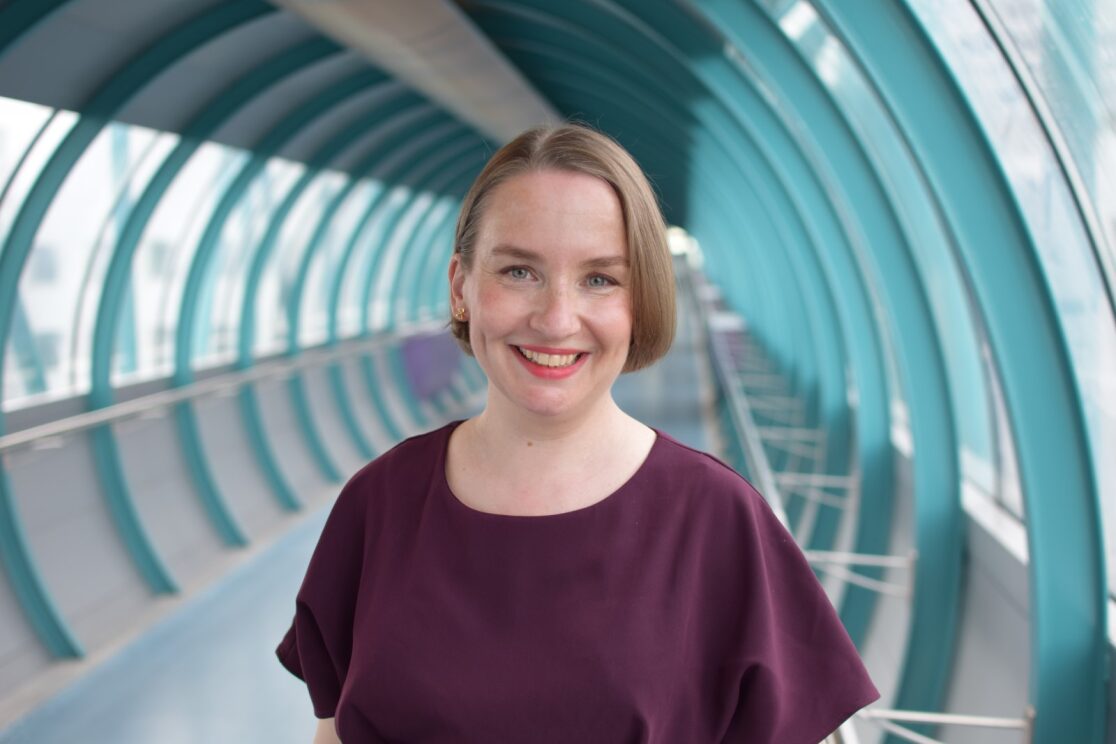
Photo: Juhani Valtasalmi
Kielipankki – The Language Bank of Finland offers a comprehensive set of resources, tools and services in a high-performance environment. Idastiina Valtasalmi tells us about her research on linguistic affect, i.e. the expression of emotions and attitudes in language. The topic stemmed from her earlier research on Easy Finnish.
I am Idastiina Valtasalmi and I am a postdoctoral researcher of Finnish language at Tampere University. Currently, I research linguistic affect and bias-free language in a project called Tampere in emotions, funded by Kone Foundation. Previously, I have completed my doctoral thesis, which examines the vocabulary of Easy Language, and especially Easy Finnish, from text and user perspectives. Easy Language is a simplified form of language that varies by situation. It can be used to remove barriers of accessibility in communication.
I study linguistic affect, i.e. the expression of emotions and attitudes in language. My research focuses on bias-free language and referring to different groups of people in an inclusive, appreciative and respectful manner. Biased expressions are the flip side of my research, because non-discrimination is examined in relation to discrimination. Language is also constantly changing, and expressions previously considered as neutral can become discriminatory in tone over time. Bias-free Finnish is an important research topic, as it has not gained much attention in research, and English has been used as a model for practical writing guidelines. However, the structures of Finnish and English are different, and the guidelines for English are not suitable to be used in Finnish.
My current research topics are related to my earlier research, as I have already observed bias-free expressions used in Easy Finnish texts in my doctoral thesis. It can be said that my current research topics partly stemmed from the research results of my doctoral thesis.
I have used corpus research, questionnaires and linguistic tests as research methods. The corpora available via the Language Bank of Finland have been valuable, as they are of high quality and easily accessible. The corpora have also been useful, for example, in preparing questionnaires and tests, for which I have selected words based on their frequency. Of all the corpora of the Language Bank, I am particularly fond of resources which contain Easy Finnish texts of current affairs and news: Leija, Selkosanomat/Selkouutiset and Easy Finnish texts from the Yle News Archive. I find that such extensive collections of Easy Language texts are relatively rare, even worldwide. The corpora therefore provide Easy Finnish researchers with excellent opportunities for text-based research.
Valtasalmi, Idastiina – Siltaloppi, Satu – Wacklin, Vilma – Mustanoja, Liisa 2025: Kymmenen havaintoa syrjimättömästä kielestä. – Kaisa Jänis & Iiris Salminen (toim.), Kieli ja kirjallisuus muuttuvassa yhteiskunnassa s. 99–129. Äidinkielen opettajain liiton vuosikirja 2025. Äidinkielen opettajain liitto.
Valtasalmi, Idastiina 2024: Teksti- ja käyttäjänäkökulmia selkokielen sanastoon. Tampere: Tampereen yliopisto. https://urn.fi/URN:ISBN:978-952-03-3538-0.
Valtasalmi, Idastiina 2023: Essiivin funktiot ja käyttö perustason selkokielessä. Virittäjä, 127(1), s. 4–27. https://doi.org/10.23982/vir.111948.
The FIN-CLARIN consortium consists of a group of Finnish universities along with CSC – IT Center for Science and the Institute for the Languages of Finland (Kotus). FIN-CLARIN helps the researchers of Social Sciences and Humanities to use, refine, preserve and share their language resources. The Language Bank of Finland is the collection of services that provides the language materials and tools for the research community.
All previously published Language Bank researcher interviews are stored in the Researcher of the Month archive. This article is also published on the website of the Faculty of Arts of the University of Helsinki.

Photo: Jocelyn Parot
Kielipankki – The Language Bank of Finland offers a comprehensive set of resources, tools and services in a high-performance environment. Rea Peltola tells us about her research on the semantics of animacy.
I am Rea Peltola, Professor of Finnish language and culture and Head of the Department of Nordic Studies at the University of Caen in Normandy, France. I am a member of the CRISCO research group. I am also a docent of the Finnish language at the University of Helsinki.
My roots are in the study of modal meaning structures, particularly in what is known as post-modality. It investigates the fading of modal meanings, or rather their intersubjective reorientation. Gradually, studying the expressions of permission and ability brought me to reflect on the semantics of animacy. I became interested in how grammar describes the characteristics of living beings, especially in terms of embodiment. For more than ten years now, I have been studying how human language deals with being an animal: How do we talk about other animals and their bodily experiences? How is human language used when interacting with another animal?
In the thematic issue on interspecies pragmatics, co-edited with Mika Simonen, I studied reported animal inner speech in dialect data. At the time, I went through all the interviews in the Eastern dialects of the Finnish Dialect Corpus of the Syntax Archive, and collected passages where the speakers verbalised the thoughts of other species (e.g., se kuuloo hirvi että tuolla se mennöö se vihamies ’the moose can hear, like there he goes, the enemy’, Suomussalmi). These occurred especially when talking about hunting practices or work with another animal (usually a dog or horse). In general, these passages described how animals reasoned based on their sensory perception.
With Outi Duvallon, we have analysed the Language Bank of Finland’s corpora to investigate the modal meaning and use of the Finnish sai kuin saikin (’V1 kuin V1=kin’) type of reduplicative construction in text corpora from different time periods, particularly in Early Modern Finnish, as well as contemporary language use in the Yle News Archive and the Suomi24 online discussion. We noticed, for example, that the epistemic use of the construction that was at the time perhaps still in formation (e.g. tässä minä sinun nuorin poikasi olen, kuin olenki ’here I am, your youngest son, as sure as I stand’, Salmelainen 1863), already present in older material, has gained new momentum in the chain-like structures of online conversations. The reduplicative construction can be used to align with the position of the other participant expressed in an earlier message (e.g., laulajalla on kuin onkin loistava ääni ’the vocalist indeed has an excellent voice’, Suomi24).
Recently, Arnaud Godet and I have been investigating Finnish modal verbs that express rather specific abilities related to the circumstances, such as tarjeta (’to not to be cold’), jaksaa (’to have enough energy’), malttaa (’to have patience’) and raaskia (’to have the heart to do something’). We analysed their grammar and uses in the classics of literature, in the journals of the 1990s and 2000s, and in the Finnish Dialect Corpus of the Syntax Archive and Digital Morphology Archives. We also obtained a small amount of data from the Arkisyn conversations. We compared the selected verbs in terms of complement constructions, person reference and negative affinity. Our aim was to shed light on their shared force dynamics structure underlying their meanings and, on the other hand, to understand the mutual relationships and division of labour between these verbs.
Duvallon, Outi & Peltola, Rea. 2025. La construction réduplicative finnoise V1 kuin V1=kin : une ressource modale et discursive. Études finno-ougriennes. In press.
Peltola, Rea. 2023. Verbalizing animal inner speech. Journal of Pragmatics 217, 109–122. DOI: 10.1016/j.pragma.2023.09.005.
Peltola, Rea. 2021. Unfolding constructions: Postmodal auxiliaries in mirative complement patterns. Teoksessa Hilpert, Martin & Cappelle, Bert & Depraetere, Ilse (toim.), Modality and Diachronic Construction Grammar, 149–184. Amsterdam: John Benjamins. DOI: 10.1075/cal.32.06pel.
The FIN-CLARIN consortium consists of a group of Finnish universities along with CSC – IT Center for Science and the Institute for the Languages of Finland (Kotus). FIN-CLARIN helps the researchers of Social Sciences and Humanities to use, refine, preserve and share their language resources. The Language Bank of Finland is the collection of services that provides the language materials and tools for the research community.
All previously published Language Bank researcher interviews are stored in the Researcher of the Month archive. This article is also published on the website of the Faculty of Arts of the University of Helsinki.
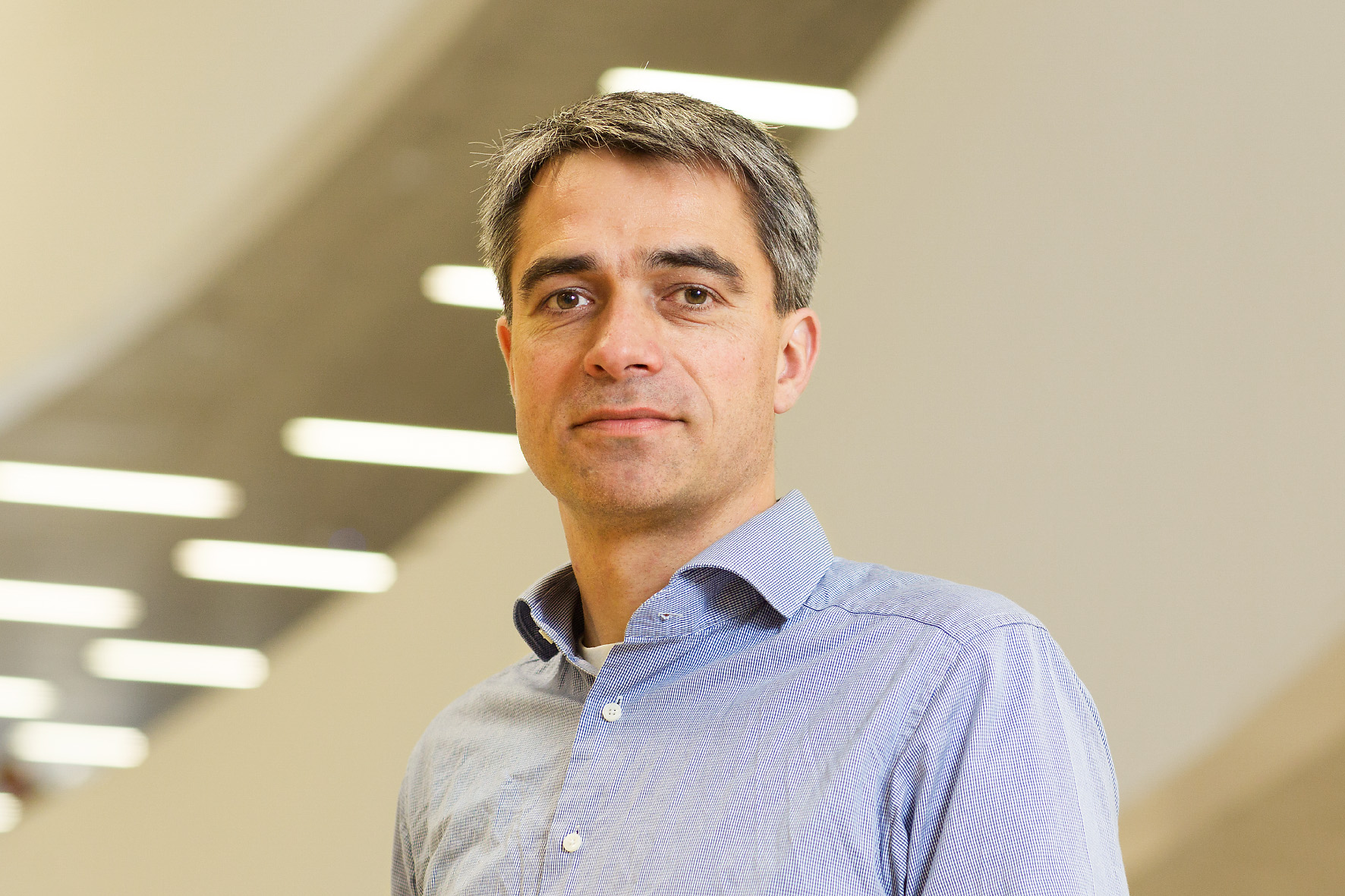
Photo: Linda Tammisto
Kielipankki – The Language Bank of Finland offers a comprehensive set of resources, tools and services in a high-performance environment. Jörg Tiedemann tells us about his work with resource development and OPUS, the World’s largest collection of openly available parallel translation datasets with a wide language coverage.
My name is Jörg Tiedemann and I am leading the language technology research group at the University of Helsinki. We are part of the Department of Digital Humanities and our students have a study track in the BA in Languages and the MA on Linguistic Diversity and Digital Humanities. My own background is in computer science from my undergraduate studies in Germany and computational linguistics from my doctoral studies in Uppsala, Sweden. The appointment as professor in language technology in Helsinki started in 2015 and since then I enjoy the multidisciplinary environment in our team.
My main research interests are connected with multilingual natural language processing from various perspectives. A lot of my work has been devoted to application-oriented research in particular in the field of machine translation (MT). Resource development has been a big part of my life and, already during my PhD, a lot of my time went into the collection and alignment of large, multilingual parallel corpora. For more than two decades, I have maintained OPUS, the World’s largest collection of openly available parallel translation datasets with a wide language coverage. This collection has been a main source for the development of translation technology world-wide and its language coverage is unique and invaluable for research on inclusive NLP.
In recent years, we pushed our efforts into the extension of the OPUS ecosystem to cover all aspects of MT development from data to tools and deployment. Pre-trained translation models are available from OPUS-MT, software packages are released for data manipulation, training, distilling, deploying and evaluating models. Web interfaces, applications, professional translation toolkits such as OPUS-CAT and dashboards support research, development and use, and our resources belong to the most popular ones on the Hugging Face model and data hub.
Another line of research is related to basic research on multilingual and cross-lingual NLP. The ERC project FoTran focused on representation learning with massively multilingual data and we investigated transfer learning capabilities, modularity and interpretability of large neural translation models. We also looked at uncertainty modeling in another research project and currently focus, among other things, on efficiency of NLP in order to reduce the ever-growing carbon footprint of language technology (within the GreenNLP project).
Finally, our research group is also devoting time to the development of large language models as part of the European project HPLT and OpenEuroLLM. Our contribution to those projects is mostly connected to multilinguality and evaluation, two very important and challenging topics in the field as a whole. Our goal is to push support for otherwise under-represented languages and also to improve multilingual evaluation and to reduce the effect of so-called “hallucinations” of generative AI.
Most of our research is data-intensive and heavily depends on data collections, empirical evaluation and iterative training of models with compute-heavy machine learning. Language resources are essential in this process and we are both, providers and users, of the Language Bank of Finland. Even though most of our work is focused on machine learning and model development, we are also very much interested in making our resources available for research in the humanities. Many of the datasets we curate are directly interesting for linguistic research or, for example, in translation studies. Similarly, linguistic resources are essential for training, tuning and evaluating neural language models. Furthermore, such language models become essential tools in humanities as well and their influence will steadily grow also in linguistic studies, social sciences and various fields of traditional humanities.
Tiedemann, J., Aulamo, M., Bakshandaeva, D. et al. 2024. Democratizing neural machine translation with OPUS-MT. In Lang Resources & Evaluation 58, 713–755 (2024). https://doi.org/10.1007/s10579-023-09704-w
Mikko Aulamo, Nikolay Bogoychev, Shaoxiong Ji, Graeme Nail, Gema Ramírez-Sánchez, Jörg Tiedemann, Jelmer van der Linde, and Jaume Zaragoza. 2023. HPLT: High Performance Language Technologies. In Proceedings of the 24th Annual Conference of the European Association for Machine Translation, pages 517–518, Tampere, Finland. European Association for Machine Translation. https://aclanthology.org/2023.eamt-1.61/
Jörg Tiedemann and Ona de Gibert. 2023. The OPUS-MT Dashboard – A Toolkit for a Systematic Evaluation of Open Machine Translation Models. In Proceedings of the 61st Annual Meeting of the Association for Computational Linguistics (Volume 3: System Demonstrations), pages 315–327, Toronto, Canada. Association for Computational Linguistics. DOI: https://doi.org/10.18653/v1/2023.acl-demo.30
Tiedemann, J 2022, From open parallel corpora to public translation tools: The success story of OPUS. In E Volodina, D Dannélls, A Berdicevskis, M Forsberg & S Virk (eds.), LIVE and LEARN : Festschrift in honor of Lars Borin. Research Reports from the Department of Swedish, Multilingualism, Language Technology, Nro GU-ISS-2022-03, University of Göteborg, Göteborg, Sivut 133-138. http://hdl.handle.net/10138/351496
The FIN-CLARIN consortium consists of a group of Finnish universities along with CSC – IT Center for Science and the Institute for the Languages of Finland (Kotus). FIN-CLARIN helps the researchers of Social Sciences and Humanities to use, refine, preserve and share their language resources. The Language Bank of Finland is the collection of services that provides the language materials and tools for the research community.
All previously published Language Bank researcher interviews are stored in the Researcher of the Month archive. This article is also published on the website of the Faculty of Arts of the University of Helsinki.
Photo: Therese Lindström Tiedemann
Kielipankki – The Language Bank of Finland offers a comprehensive set of resources, tools and services in a high-performance environment. Daniela Piipponen tells us about her research on historical linguistics and introduces the Digisvenska project.
I am Daniela Piipponen, a doctoral student in Scandinavian languages at the University of Helsinki.
Much of my own research concerns historical linguistics and the variety of Swedish used in Finland during the 19th and early 20th centuries, focusing on issues related to the standardisation of the written language. In my thesis, I investigate orthographic and morphological variation in the reading book Boken om vårt land (’The Book of Our Country’) by Zacharias Topelius in relation to the contemporary language norms.
In addition to my thesis, I have also researched (modern) Learner Swedish, and I have participated in the Digisvenska project (funded by the Swedish Cultural Foundation in Finland 2022–2024), a collaboration between the Faculty of Educational Sciences and the Faculty of Arts at the University of Helsinki (project leader Raili Hildén; the Faculty of Arts’ part was led by Therese Lindström Tiedemann). The overall aim of the project was to study fairness aspects in the B-Swedish matriculation examination (see also the project blog).
In my research on language history, including parts of my thesis, I have often turned to the Language Bank’s collection of Newspaper and Periodical Corpus of the National Library of Finland to examine the language used in Swedish-language Finnish newspapers in the 19th century. The language of newspapers is a relatively standardised type of text that can be investigated over a longer period of time. In addition, there are possibilities for comparisons with the corresponding Swedish newspaper corpora maintained by Språkbanken Text in Gothenburg.
Within the Digisvenska project, we have also worked to develop two Learner Swedish corpora: Digisvenska corpus and Digisvenska Norm. Both corpora will also be available to other researchers via the Language Bank (however, use requires permission from the Matriculation Examination Board of Finland). The corpora are based on the performances of free writing from the digital matriculation examination in B-Swedish during eight test rounds between spring 2018 and autumn 2021. The Digisvenska corpus includes all written performances from the aforementioned test rounds, and contains a total of over 10 million tokens. Digisvenska Norm is a smaller subcorpus consisting of a total of 96 texts from two test rounds, where the texts have been manually normalized according to the norms of the standard language. The normalized corpus has been realized as a parallel corpus, allowing the normalized text to be compared with the original.
Within the project, we have used the corpora to investigate the linguistic breadth and accuracy of the texts and how these relate to the assessment. For example, together with Therese Lindström Tiedemann, I have analysed the verb conjugation in the material to see which tense forms are used at different skill levels, as well as whether the forms have been used according to the norms. I have also looked at the orthography and where it causes problems. In this case, I was also able to use the Studentsvenska 79/80 corpus to compare the results with those of older Swedish matriculation examinations. Finally, we also hope to continue to develop and use the material in the future. We are investigating the possibility of funding for further research, and have also worked to add correction annotations to the normalized material to improve the analysis tools.
Piipponen, Daniela. 2025. ”Låt din penna vara sig sjelf trogen” Variation och norm i Zacharias Topelius läsebok Boken om vårt land, med fokus på ortografi och morfologi. Helsingfors universitet. PhD Thesis. http://urn.fi/URN:ISBN:978-952-84-1317-2
Piipponen, Daniela, Lindström Tiedemann, Therese & Axelson, Erik. 2024. Digisvenska-korpusen: en inlärarkorpus baserad på studentprovet i B-svenska. In Kolu m.fl (eds.): Svenskan i Finland 20, p. 140–154. http://urn.fi/URN:ISBN:978-952-61-5327-8
Piipponen, Daniela. 2023. Herrarne och damerna. Variationen i den plurala definita substantivböjningen i Sverige och i Finland på 1800-talet. In Språk och stil NF 33, p. 71–106. https://doi.org/10.61965/sos.33.2023.18946
The FIN-CLARIN consortium consists of a group of Finnish universities along with CSC – IT Center for Science and the Institute for the Languages of Finland (Kotus). FIN-CLARIN helps the researchers of Social Sciences and Humanities to use, refine, preserve and share their language resources. The Language Bank of Finland is the collection of services that provides the language materials and tools for the research community.
All previously published Language Bank researcher interviews are stored in the Researcher of the Month archive. This article is also published on the website of the Faculty of Arts of the University of Helsinki.
Photo: Maarit Kytöharju
Kielipankki – The Language Bank of Finland offers a comprehensive set of resources, tools and services in a high-performance environment. Pekka Posio tells us about a research project that explores the link between gender and language use in the Spanish-speaking world. The extensive CoLaGe Corpus compiled during the project will be available via the Language Bank.
I am Pekka Posio, Professor of Ibero-Romance Languages at the Faculty of Arts, University of Helsinki. I focus on Spanish and Portuguese, and examine sociolinguistics, pragmatics and language change and variation. Currently, I am the head of discipline for Portuguese, Galician and Basque languages.
I studied Romance Languages and General Linguistics at the University of Helsinki, where I obtained my PhD in 2012. The topic of my dissertation was the expression of subject pronouns in Spanish and Portuguese. During my post doc phase, I worked in Salamanca, Berlin, Cologne and Ghent, studying impersonal constructions in Spanish and Portuguese. I also worked for three years as a university lecturer in Spanish at Stockholm University before returning to Helsinki in 2019 as an associate professor. In 2024, I was appointed as a professor.
Currently, my research focuses on language and gender in the Spanish-speaking world and I lead the research project Gender, Society, and Language Use: Evidence from Mexico and Spain (2021-2025), funded by the Kone Foundation. Language and gender is a well-established area of research in the study of the English language and English linguistics, but has received less attention in Spanish studies.
In this project, we are particularly interested in the mechanisms that link society and gender to language use, and whether there are differences in the relationship between gender and language in different societies that use the same language. These questions will be approached through both sociolinguistics and social psychology. We have collected a wide range of data, including both spoken and transcribed language and socio-psychological data on our informants. By combining these data, we will be able to explore the links between language and gender in a completely new way and at the same time renew the concept of gender as a sociolinguistic variable. In addition to the traditional comparison of female and male speech, we use scalar variables such as speakers’ perceptions of their own masculinity and femininity, and gender-related attitudes and perceptions.
We study different phenomena of language use – for example, the prevalence of different grammatical persons and ways of interacting in speech – in two societies that share the same language but differ in terms of gender roles and norms. We collected data between 2022 and 2023 in Guadalajara, Mexico, and Valencia, Spain. The research data generated by this project will help to broaden and diversify our understanding of gender and its manifestations, particularly in the societies we studied.
The post doc researchers in this project are Gloria Uclés Ramada, Sven Kachel, Andrea Carcelén Guerrero and Fien de Latte. The project has also employed a number of students as data collectors, transcribers and coders in Finland, Spain, Mexico and Germany.
We have produced a corpus called Corpus for the Study of Language and Gender in Mexico and Spain (CoLaGe), which contains 111 hours and over one million words of recorded and transcribed speech from 127 informants. The corpus is divided into a sub-corpus for Valencia (CoLaGe-V) and Guadalajara (CoLaGe-G), and a smaller CoLaGe-D(iversity) corpus collected in Guadalajara, with informants representing gender and/or sexual minorities. In collecting the data, we have tried to obtain data that are as comparable as possible, with speakers from two age groups (30-40 and 60-70) and two countries. The data include sociolinguistic interviews, role-plays simulating conflict situations and material elicited for phonetic research in which informants describe images they have seen.
In addition to comparability, the collection of data was guided by the need to make all the extensive material available to other researchers, which is why a great deal of attention has been paid to issues such as pseudonymisation. The majority of the speech material has also been recorded on studio equipment, which allows it to be used for phonetic analysis. The Language Bank of Finland has been a natural location for the CoLaGe corpus since its inception. The social psychology data from the project will also be made available to researchers via the Finnish Social Science Data Archive.
Carcelen Guerrero, A., Posio, P., Kachel, S. & Uclés Ramada, G. (Accepted 2025). CoLaGe: Corpus for the study of language and gender in two varieties of Spanish. Corpora. https://researchportal.helsinki.fi/files/328418218/CoLaGe-accepted.pdf
Uclés Ramada, G., Kachel, S. & Posio, P., 2025. Conflict, gender, and amount of talk: Gender differences in Spanish role play data. Pragmatics and Society. DOI: 10.1075/ps.23144.ucl
Posio, P., Kachel, S., & Uclés Ramada, G. 2024. Morphosyntactic stereotypes of speakers with different genders and sexual orientations: an experimental investigation. Linguistics. DOI: 10.1515/ling-2022-0143
More publications from Pekka Posio: https://researchportal.helsinki.fi/en/persons/pekka-posio
Corpus for the Study of Language and Gender in Mexico and Spain (CoLaGe)
The FIN-CLARIN consortium consists of a group of Finnish universities along with CSC – IT Center for Science and the Institute for the Languages of Finland (Kotus). FIN-CLARIN helps the researchers of Social Sciences and Humanities to use, refine, preserve and share their language resources. The Language Bank of Finland is the collection of services that provides the language materials and tools for the research community.
All previously published Language Bank researcher interviews are stored in the Researcher of the Month archive. This article is also published on the website of the Faculty of Arts of the University of Helsinki.
Photo: Veikko Somerpuro
Kielipankki – The Language Bank of Finland offers a comprehensive set of resources, tools and services in a high-performance environment. Simo Määttä tells us about his research that is based on sociological translation studies, critical sociolinguistics and critical discourse studies.
I am Simo Määttä, Assistant Professor of Translation Studies at the Faculty of Arts, University of Helsinki. I am Head of the Translation Studies Research Community TRAST and hold a title of docent in French Studies. I teach in the Master’s programme in Translation and Interpreting at the University of Helsinki. I am Chair of the Board of the Register of Legal Interpreters.
I received my PhD from the University of California, Berkeley in 2004 and have since worked at several universities in Finland, and since 2014 at the University of Helsinki.
My research is based on sociological translation studies, critical sociolinguistics and critical discourse studies. I am interested in how language use and other interactions are represented and what meanings are given to linguistic interactions – especially multilingual communication and linguistic variation.
One of my main research interests is public service (or community) and legal interpreting. In this field, I examine language ideologies, accuracy of interpreting, multimodality, the agency of participants in the interpreter-mediated encounter, the expression of empathy and the realisation of linguistic rights. In particular, I have studied lingua franca interpreting, where both the interpreter and the client speaking a foreign language communicate in a language that is not their first language. This is common, for example, when an asylum seeker, migrant or foreign national suspected of or victim of a crime communicates with an interpreter in French or English.
I lead the Translation, Immigration and Democracy project (2022-2025) funded by the Kone Foundation, where our research team analyses translation policies and practices in multilingual communication targeted to migrant populations. The research focuses on organisations (e.g. municipalities, organisations, companies, universities, media) operating in the Helsinki metropolitan area (Helsinki, Espoo and Vantaa) and in Tallinn. The project combines theories and methods of functionalist and sociological translation studies and critical linguistics.
The project is founded on the idea that multilingualism constitutes not only an opportunity for democracy, but also a challenge: the language barrier prevents migrants from participating in social, cultural and political life and from becoming full members of their local community and society. Translation aims to promote migrants’ access to information and participation, but it does not reach all migrants. The project approaches translation as a practice of governmentality, through which power is exercised and produced. One of the objectives is to propose new solutions, together with different actors, to improve the quality of translation policies and practices.
I am also involved in the EU Horizon-funded project ARENAS (Analysis of and Responses to Extremist Narratives), coordinated by Professor Julien Longhi (Cergy Paris Université), in which our international, multidisciplinary consortium analyses the extremist narratives affecting and threatening European political and social life. We explore the nature of extremist narratives and seek to understand them, in particular those concerning science, gender and the Nation. By understanding how these narratives work, we aim to find ways to counter extremist narratives and thus contribute to the harmonious development of Europe.
Within the ARENAS project, I am involved in a work package related to the circulation of extremist narratives, coordinated by historian Steven Forti from the Autonomous University of Barcelona. The ARENAS team in Helsinki is led by Dr. Katalin Miklóssy, Jean Monet Professor and Associate Professor of Political History. I am responsible for a task of qualitative research on how extremist narratives circulate between political discourse, traditional media and new media. The qualitative data for the study is selected on the basis of the quantitative data produced and analysed in the other tasks of the work package.
I also analyse the theory of discourse, ideology (especially language ideology), performativity, and hate speech. My previous research has focused on the translation of sociolinguistic variation in literature and language policies related to regional and minority languages.
In the part of the ARENAS project that I am responsible for, we use the corpora available in the Language Bank on speeches made in the Finnish Parliament, especially in plenary sessions. These data have allowed us to see exactly how the topics discussed in traditional and new media correspond to the political debate in Parliament. In addition, our research has made use of the ParlaMint corpus and a corpus compiled for the ARENAS project, which consists of social media posts by politicians in different countries.
I also used the Suomi24 corpus from the Language Bank in a study co-authored with Yrjö Lauranto to examine how online discussants express dissenting and sympathetic opinions about gender and sexual minorities. We also used Suomi24 data in articles written with Ulla Tuomarla and Karita Suomalainen in Finnish and English, analysing discussions on immigration.
Määttä, S. & Kinnunen, T. 2024. The Interplay between Linguistic and Non-verbal Communication in an Interpreter-mediated Main Hearing of a Victim’s Testimony. Multilingua: Journal of Cross-Cultural and Interlanguage Communication 43(3), 299–330. DOI: 10.1515/multi-2023-0153
Määttä, S., Kinnunen, T., Kuusi, P. & Probirskaja, S. 2024. Kohderyhmätietous monikielisen kriisiviestinnän asiantuntijatyössä koronapandemian aikana. Työelämän tutkimus 22(4), 555–587. https://journal.fi/tyoelamantutkimus/article/view/142675
Määttä, S. 2023. Linguistic and Discursive Properties of Hate Speech and Speech Facilitating the Expression of Hatred: Evidence from Finnish and French Online Discussion Boards. Internet Pragmatics 6(2), 156–172. DOI: 10.1075/ip.00094.maa
Määttä, S. & Wiklund, M. 2023. Resolving Comprehension Problems in a Telephone-interpreted Screening Interview. Teoksessa: E. de Boe, J. Vranjes & H. Salaets (toim.) Interactional Dynamics in Remote Interpreting: Micro-analytical Approaches. New York: Routledge, 42–65. https://www.routledge.com/Interactional-Dynamics-in-Remote-Interpreting-Micro-analytical-Approaches/Boe-Vranjes-Salaets/p/book/9781032213286
Määttä, S. & Hall, M. 2022. Ideology and Discourse: Convergent and Divergent Developments. Teoksessa: S. Määttä & M. Hall (toim.) Mapping Ideology in Discourse Studies. Boston & Berlin: De Gruyter Mouton, 1–20. DOI: 10.1515/9781501513602-001
Määttä, S. & Lauranto, Y. 2022. Eriävän ja myötämielisen mielipiteen esittäminen sukupuoli- ja seksuaalivähemmistöjä koskevissa Suomi24-keskusteluissa. Virittäjä 126(2), 205–230. https://journal.fi/virittaja/article/view/100240
Määttä, S., Puumala, E. & Ylikomi, R. 2021. Linguistic, Psychological, and Epistemic Vulnerability in Asylum Procedures: An Interdisciplinary Approach. Discourse Studies 23(1), 46–66. DOI: 10.1177/1461445620942909
Määttä, S., Suomalainen, K. & Tuomarla, U. 2021. Everyday Discourse as a Space of Citizenship: The Linguistic Construction of In-groups and Out-groups in Online Discussion Boards. Citizenship Studies 25(6), 773–790. DOI: 10.1080/13621025.2021.1968715
Vernet, S. & Määttä, S. 2021. Modalités syntaxiques et argumentatives du discours homophobe en ligne : chroniques de la haine ordinaire. Mots – Les langages du politique 125, 35–51. https://journals.openedition.org/mots/27943
Määttä, S., Suomalainen, K. & Tuomarla, U. 2020. Maahanmuuttovastaisen ideologian ja ryhmäidentiteetin rakentuminen Suomi24-keskustelussa. Virittäjä 124(2), 190–216. https://journal.fi/virittaja/article/view/81931
The FIN-CLARIN consortium consists of a group of Finnish universities along with CSC – IT Center for Science and the Institute for the Languages of Finland (Kotus). FIN-CLARIN helps the researchers of Social Sciences and Humanities to use, refine, preserve and share their language resources. The Language Bank of Finland is the collection of services that provides the language materials and tools for the research community.
All previously published Language Bank researcher interviews are stored in the Researcher of the Month archive. This article is also published on the website of the Faculty of Arts of the University of Helsinki.
Photo: Sigga-Marja Magga
Kielipankki – The Language Bank of Finland offers a comprehensive set of resources, tools and services in a high-performance environment. Marko Jouste tells us about his research on Sámi culture and about his work with the Giellagas Corpus of Spoken Sámi languages.
I am Marko Jouste, a university lecturer and associate professor (Title of docent) specializing in Sámi culture at the Giellagas Institute for Sámi Studies, University of Oulu. Since the early 2010s, I have been an active member of the Giellagas Institute, where my research focuses on various aspects of Sámi culture, including music, history, and heritage. Additionally, I serve as the main developer of the Sámi Cultural Archive, located within the institute. Beyond my academic duties, I also work as a musician, performing with music groups such as Ulla Pirttijärvi & Ulda and Suõmmkar.
My research focuses primarily on Sámi music, culture and history, with a particular emphasis on historical audio recordings. Currently, I am leading several active research projects, including The Northern Sámi Fairy Tale Book 1956 – Returning Historical Archive Material to the Community and Developing Ethical and Legal Practices for Open Access (funded by the Kone Foundation), and Skolt Sámi Dance: The Transformative Journey of Tradition, Resilience, and the Arctic Quadrille, a collaborative project with dance researcher Petri Hoppu (funded by the Jenny and Antti Wihuri Foundation). Another project is Jaakko Sverloff’s Life Story – From Suonikylä in Petsamo Through the World Wars to a Leader of the Skolt Sámi (also supported by the Jenny and Antti Wihuri Foundation).
Additionally, I have contributed to the Research Council of Finland’s key project, the Skolt Sámi Memory Bank. This pilot project, operational between 2016 and 2018, focused on the management and cultural revitalization of Skolt Sámi music, language, and cultural materials preserved in sound archives in Finland. Through these projects, I aim to promote community engagement, advance ethical practices in archival work, and contribute to the revitalization and preservation of Sámi cultural heritage.
Kielipankki – The Language Bank of Finland is closely connected to my research through its integration with archival work. Since the 2010s, the Sámi Cultural Archive has collaborated with the Language Bank to develop Sámi language materials for broader use in both academic research and Sámi language communities. The Giellagas Institute’s Corpus of Spoken Sámi Languages currently includes three Sámi languages spoken in Finland: Northern Sámi, Aanaar (Inari) Saami, and Skolt Saami. Notably, the first sub corpus added to the Language Bank was the Northern Sámi sample corpus. In spring 2025, this collection will be expanded with the inclusion of the Aanaar Saami spoken language corpus.
The FIN-CLARIN consortium, which is the organization behind the Language Bank of Finland, has also provided funding for corpus development work at the Sámi Cultural Archive in 2014, 2019, and 2022. This collaboration significantly enhances the accessibility, preservation, and usability of Sámi language materials, aligning with my broader focus on Sámi culture and heritage. In my research, I extensively use language technology tools such as the Korp service, which facilitates the analysis and exploration of linguistic data, particularly in the context of Sámi languages.
Petri Hoppu & Marko Jouste (2025). Skolt Saami Dance: The Transformative Journey of Tradition, Resilience, and the Arctic Quadrille. London: Bloomsbury. [Painossa]
Jouste, Marko (2022) ”Skolt Saami Leuʹdd. Tradition as a medium of individual and collective remembrance”. The Sámi World. Edited by Sanna Valkonen, Áile Aikio, Saara Alakorva and Sigga-Marja Magga. London: Routledge, pp. 53–71.
Jouste, Marko & Mettovaara, Jukka & Morottaja, Petter & Partanen, Niko (2022). Archive Infrastructure and Spoken Language Corpora for Saami Languages in Finland. The 6th Digital Humanities in the Nordic and Baltic Countries 2022 Conference (DHNB 2022), Uppsala, Sweden, March 15-18, 2022. CEUR Workshop Proceedings. Aachen: RWTH Aachen University, pp. 269–278. https://ceur-ws.org/Vol-3232/paper25.pdf
Jouste, Marko & Lehtola, Veli-Pekka & Juutinen, Markus & Tanhua, Sonja (2022). ”Jääkk Sverloff johtajana ja kulttuuritulkkina – Kolttasaamelaisten historian käänteitä 1900-luvulla”. [Jääkk Sverloff as a Leader and a Cultural Interpreter – Turning points of Skolt Saami history in 20th century]. Suomen rajaseutujen kolonialismi. [Colonialism of Finnish Borderlands]. Toim. Rinna Kullaa, Janne Lahti ja Sami Lakomäki. Helsinki: Gaudeamus.
Jouste, Marko (2020). ”Suonikylän kolttasaamelainen itkuperinne 1900-luvulla”. [The Skolt Saami Lament Tradition of Suonikylä in the 20th Century]. Etnomusikologian vuosikirja Vol 32. Toim. Janne Mäkelä, Kaj Ahlsved, Viliina Silvonen. Helsinki: Suomen etnomusikologinen seura, pp. 10–45. https://doi.org/10.23985/evk.90118
Marko Jouste, Markus Juutinen, Eino Koponen (2020). ”Kolttasaamelaisen Näskk Moshnikoffin leuʹdd-kielen idiolekti ”. [The Idiolect of leuʹdd Language of Skolt Saami Näskk Moshnikoff]. Kulttuurintutkimus Vol 37, 1–2, pp. 32–56. Toim. Janne Saarikivi, Pirjo Kristiina Virtanen. Joensuu: Kulttuurintutkimuksen seura ry. https://journal.fi/kulttuurintutkimus/article/view/98099
Taarna Valtonen, Kati Kallio, Marko Jouste (2019). ”Olaus Sirman runojen vertailevaa luentaa -runojen poetiikka suhteessa suullisiin ja kirjallisiin lähikulttuureihin”. [Comparative Reading of Poems by Olaus Sirma. The Poetics of Poems in Relation to Oral and Literal Cultures Nearby]. Suomalais-Ugrilainen Seuran Aikakauskirja 97. Helsinki: Suomalais-Ugrilainen Seura, pp. 109–152. https://doi.org/10.33340/susa.75266
Marko Jouste, Markus Juutinen, Miika Lehtinen (2019): ”Isak Saba ja Paččjogas 1919:s čohkejuvvon nuortalaš leuʹddat. Isak Saba og de skoltesamiske leuʹddene som ble samlet inn i Paččjokk i 1919”. [Isak Saba and the Skolt Saami Leuʹdds Collected in Paččjogg in 1919]. Optegnelser. Isak Sabas folkeminnesamling. Čállosat. Isak Saba álbmotmuitočoakkáldat, Norsk Folkeminnelags skrifter 173 Oslo: Skandinavian Academic Press, pp. 283–301.
Jouste, Marko (2017). ”Áillohaš ja uuden joiun synty”. [Nils-Aslak Valkeapää and the Birth of the New Yoik]. Minä soin. Mun čuojan: Kirjoituksia Nils-Aslak Valkeapään elämäntyöstä. Toim. Valtonen, Taarna; Valkeapää, Leena. Rovaniemi: Lapland university press, pp. 233–258.
Marko Jouste (2011). Tullâčalmaaš kirdâččij ’tulisilmill lenteli’ – Inarinsaamelainen 1900-luvun alun musiikkikulttuuri paikallisen perinteen ja ympäröivien kulttuurien vuorovaikutuksessa. [The One Who Flew with the Fire eyes – The Musical Culture of the Aanar Sámi People in the Interaction of the Local Tradition and the Neighbouring Cultures]. Acta Universitatis Tamperensis 1650. Tampere: Tampere University Press. http://urn.fi/urn:isbn:978-951-44-8551-0
The FIN-CLARIN consortium consists of a group of Finnish universities along with CSC – IT Center for Science and the Institute for the Languages of Finland (Kotus). FIN-CLARIN helps the researchers of Social Sciences and Humanities to use, refine, preserve and share their language resources. The Language Bank of Finland is the collection of services that provides the language materials and tools for the research community.
All previously published Language Bank researcher interviews are stored in the Researcher of the Month archive. This article is also published on the website of the Faculty of Arts of the University of Helsinki.