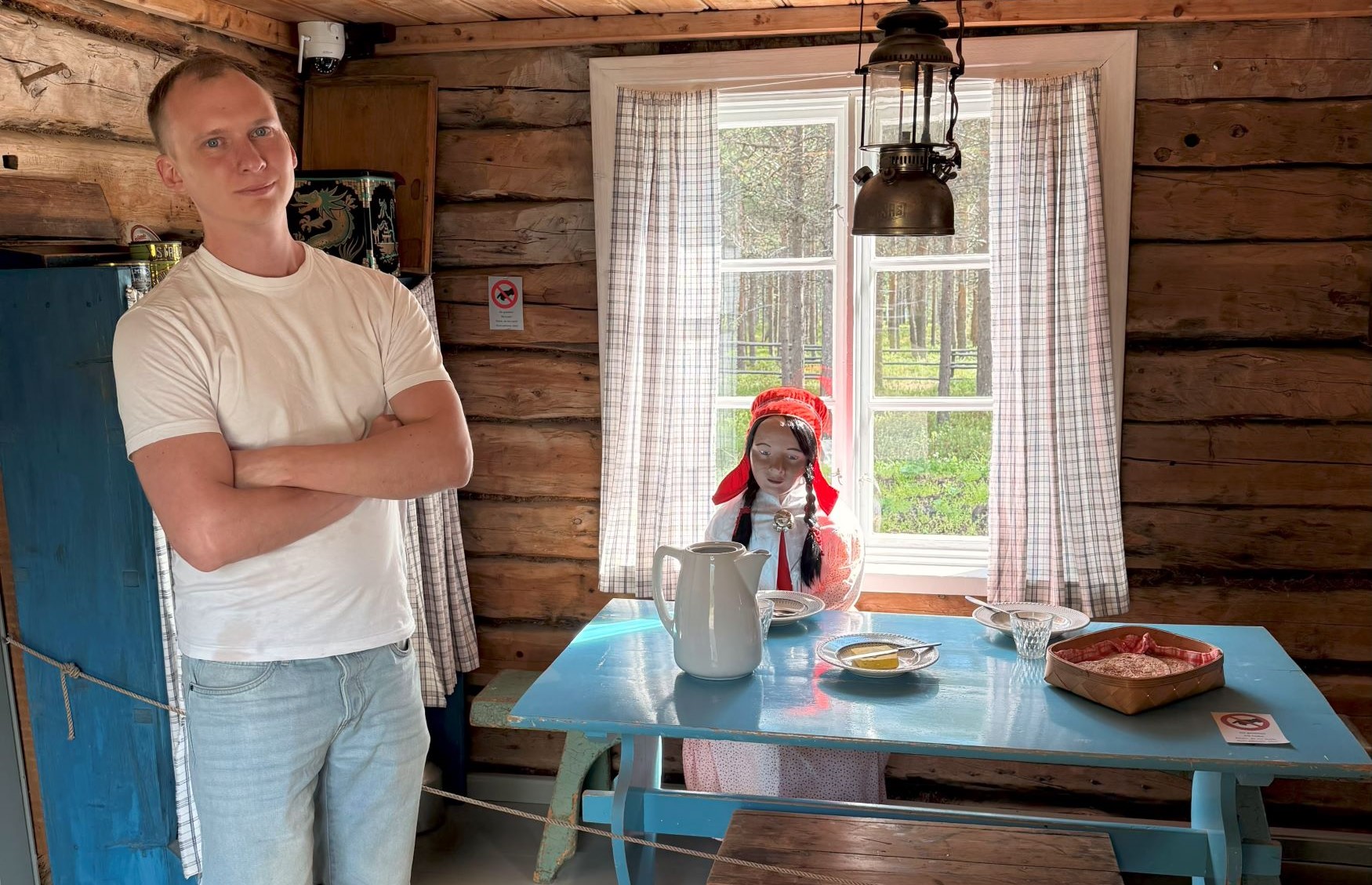
Photo: Inna Getman
Yaroslav Getman tells us about his research on self-supervised learning (SSL) for low-resource languages. Access to LUMI and Roihu supercomputers has played a crucial role in developing speech foundation models for Finnish and Northern Sámi.
I am a doctoral researcher in the Automatic Speech Recognition group at Aalto University. Before my doctoral studies, I completed a bachelor’s degree in Electrical Engineering and a master’s degree in Signal, Speech and Language Processing, also at Aalto.
My research focuses on self-supervised learning (SSL) for underrepresented languages. Most studies focus on English and other high-resource languages, while less-resourced ones lag behind in speech technology. During my PhD, I have contributed to addressing this gap for two languages, Finnish and Northern Sámi.
At a high level, my work has spanned three directions: adapting SSL models in low-resource settings, developing foundation models for underrepresented languages, and interpreting what these models learn internally.
I started my PhD in the DigiTala project, which later continued as DTA, and in Teflon. In these projects, I worked on speech recognition and pronunciation assessment for speaker groups that lack large annotated corpora, such as child speakers and second-language learners. In Teflon, we also organized the Non-native Children’s Automatic Speech Assessment Challenge (NOCASA), held as part of the IEEE MLSP 2025 conference, for which I prepared the baseline systems.
Later on, I joined the LAREINA project, where I focused on developing open-source language-specific speech foundation models. Large-scale corpora are quite rare for underrepresented languages. One option is to leverage sources that were originally intended for other purposes rather than training speech models, and extract and filter usable speech from them. I have been working with the radio and television broadcast archives maintained by KAVI (nowadays merged with the Arts Promotion Centre Finland into the Finnish Arts and Culture Agency KUVI), which have been recorded on a 24/7 basis since 2009 and amount to millions of hours of audio.
For Northern Sámi, I have developed the first publicly available self-supervised speech foundation models trained from scratch. For Finnish, the most recent models were trained on nearly half a million hours of filtered broadcast speech, a scale more typical of English models and industrial efforts.
Access to high-performance computing has played a crucial role in my PhD research. I have had the opportunity to work in two extreme-scale projects (FinW2V2 and FinSAM) on the LUMI supercomputer, and in the pilot project of Roihu, the new Finnish national supercomputer.
My research has also focused on exploring what these foundation models learn internally. I have studied how different pretraining strategies shape the resulting acoustic representations and how much of a model’s capacity is actually used for speech recognition.
Self-supervised speech foundation models are pretrained on large amounts of unlabeled speech, but they still require annotated data to perform speech recognition and other speech tasks. In my experiments, I have used the Finnish Parliament and the Lahjoita puhetta (Donate Speech) corpora extensively. Besides using data resources available in Kielipankki, I have also contributed to preparing the DigiTala second-language learner speech corpus for release there.
Getman, Y., Grósz, T., Lehtonen, T., Kurimo, M. (2026) Data filtering trade-offs in self-supervised speech representation learning: a study on unconstrained broadcast audio. Proc. Interspeech 2026, 4427-4432, doi: 10.21437/Interspeech.2026-50
Getman, Y., Grósz, T., Kurimo, M. (2026) Do learned layer weights reflect pretrained information structure in self-supervised speech models?. Proc. Interspeech 2026, 6032-6036, doi: 10.21437/Interspeech.2026-566
Getman, Y., Grósz, T., Lehtonen, T., Kurimo, M. (2025) Is your model big enough? Training and interpreting large-scale monolingual speech foundation models. Proc. Interspeech 2025, 231-235, doi: 10.21437/Interspeech.2025-46
Getman, Y., Grósz, T., Hiovain-Asikainen, K., Lehtonen, T., Kurimo, M. (2025) Towards large-scale speech foundation models for a low-resource minority language. Proc. NoDaLiDa/Baltic-HLT 2025, 192-200
Getman, Y., Grósz, T., Kurimo, M., Salvi, G. (2025) Non-Native Children’s Automatic Speech Assessment Challenge (NOCASA). Proc. IEEE MLSP 2025, 1-6, doi: 10.1109/MLSP62443.2025.11204209
The FIN-CLARIN consortium consists of a group of Finnish universities along with CSC – IT Center for Science and the Institute for the Languages of Finland (Kotus). FIN-CLARIN helps the researchers of Social Sciences and Humanities to use, refine, preserve and share their language resources. The Language Bank of Finland is the collection of services that provides the language materials and tools for the research community.
All previously published Language Bank researcher interviews are stored in the Researcher of the Month archive. This article is also published on the website of the Faculty of Humanities of the University of Helsinki.