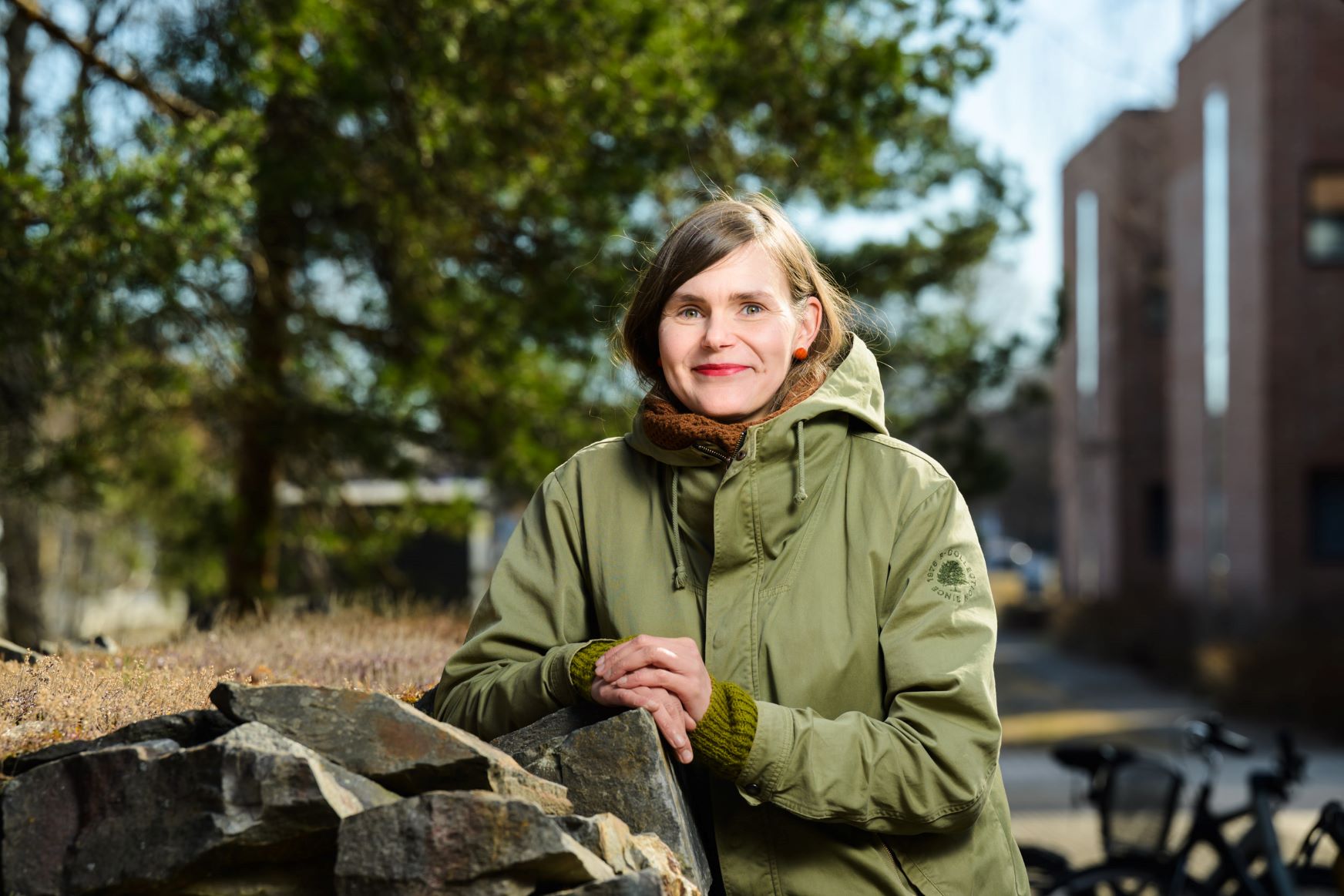
Photo: Niko Jouhkimainen
Milla Uusitupa tells us about her research on the clause structures of Finnish and Karelian dialects and on how these structures are used in interaction.
I am a researcher of Finnish and Karelian at the University of Eastern Finland, where I also work as a university lecturer in Finnish. In addition to research, my work involves advising new students and, in particular, teaching various aspects of grammar, research skills, and bachelor’s theses. I enjoy these both side of my job: it is rewarding to delve into questions that I personally find interesting, and equally enjoyable to work with students at different stages of their studies.
My research focuses on the clause structures of Finnish and Karelian dialects and on how these structures are used in interaction. I usually describe my work as interactional linguistic research on dialect syntax. In addition to grammatical research, I have studied historical multilingualism together with Vesa Koivisto, examining what the linguistic landscape looked and sounded like a hundred years ago in Border Karelia, a region north of Lake Ladoga that was then part of Finland. At present, I am also working on a manuscript related to research history, in which I explore the early stages of dialect syntax in the final decades of the nineteenth century.
I have worked with many of the corpora currently available in the Language Bank, as well as with corpora that are still forthcoming. The corpus I am most familiar with – and in many ways closest to my heart – is the Corpus of Border Karelia, which contains approximately 120 hours of interviews with Karelian-speaking evacuees recorded in the 1960s and 1970s. I first encountered this corpus while writing my master’s thesis and have continued to use it actively ever since. What fascinates me about the Corpus of Border Karelia is not only the language itself, but also the topics discussed in the interviews and the world they depict. Using this material, I have studied both the meaning and use of grammatical structures (such as the zero person, the open second-person singular, and the unipersonal passive), as well as the historical multilingualism of the Border Karelia region. Traditionally, both Karelian and Finnish were spoken in this area, and its inhabitants also maintained diverse connections with Karelians living east of the border, as well as with the Russian and Church Slavonic languages through the Orthodox Church. After Finland gained independence, this situation changed, and the influence of Finnish increased, particularly with the expansion of the Finnish public school system.
From the Karelian-language corpora in the Language Bank, I have also used the Corpus of Tver Karelian (1957–1971) in my research on Karelian modal verbs. Among the Finnish-language corpora, I am most familiar with the dialect corpora, such as the Samples of Spoken Finnish and the Follow-up Study of Dialects of Finnish. Together with Hannele Forsberg, I have used these materials to examine the open use of the second-person singular and the action sequences used to express opinions in dialect interviews.
My research questions require familiarity with a broader conversational context, and for this reason I have listened to the interviews in these corpora in their entirety, from beginning to end. This approach is time-consuming, but it makes it possible to observe not only individual forms and structures, but also what is accomplished with them in the interview situation and how the interaction between interviewer and interviewee is constructed. Even in older materials, there is still a great deal to be explored from this perspective, which takes into account the social dimensions of language use. Together with Hannele Forsberg and Maria Vilkuna, I have recently written about the electronic dialect corpora of the Language Bank in the introductory review article of the volume Sanovat syntaksiksi (’They call it syntax’).
Through my teaching work and various student assignments, I have also learned to some extent how to use other corpora in the Language Bank. For example, students often turn to the Suomi24 corpus when they begin exploring the usage of a particular word or structure. The old saying that one learns best by teaching certainly holds true.
Forsberg, Hannele – Uusitupa, Milla 2025: Murretallenteet affektisen konstruktion tutkimusaineistona. Avoin yksikön 2. persoona kantaa ottavissa toimintajaksoissa. – Milla Uusitupa, Hannele Forsberg & Maria Vilkuna (eds.), Sanovat syntaksiksi. Aineistopohjaisia tutkimuksia murteiden lauseopista pp. 461–523. SKST 1505. Helsinki: SKS. https://doi.org/10.21435/skst.1505.
Forsberg, Hannele – Uusitupa, Milla – Vilkuna, Maria 2025: Murresyntaksin tutkimusta ja aineistoja muistiinpanoista sähköisiin korpuksiin. – Milla Uusitupa, Hannele Forsberg & Maria Vilkuna (eds.), Sanovat syntaksiksi. Aineistopohjaisia tutkimuksia murteiden lauseopista pp. 22–112. SKST 1505. Helsinki: SKS. https://doi.org/10.21435/skst.1505.
Uusitupa, Milla 2021: Subjektin merkintä tverinkarjalan pidiä-, šuaha– ja voija-konstruktioissa. – Suomalais-Ugrilaisen Seuran Aikakauskirja 98 pp. 399–436. https://doi.org/10.33340/susa.95404.
Uusitupa, Milla 2021: Passiivilauseiden merkitys ja käyttö yhdellä ilomantsilaispuhujalla. – Sananjalka 63 pp. 55–78. https://doi.org/10.30673/sja.107331.
Uusitupa, Milla – Koivisto, Vesa 2020: Monikielinen Raja-Karjala. – Leena Kolehmainen, Helka Riionheimo & Milla Uusitupa (eds.), Ääniä idästä. Näkökulmia Itä-Suomen monikielisyyteen pp. 143–190. SKST 1461. Helsinki: SKS.
Uusitupa, Milla 2017: Rajakarjalaismurteiden avoimet persoonaviittaukset. Dissertations in Education, Humanities, and Theology 117. Joensuu: Itä-Suomen yliopisto. http://urn.fi/URN:ISBN:978-952-61-2646-3.
The FIN-CLARIN consortium consists of a group of Finnish universities along with CSC – IT Center for Science and the Institute for the Languages of Finland (Kotus). FIN-CLARIN helps the researchers of Social Sciences and Humanities to use, refine, preserve and share their language resources. The Language Bank of Finland is the collection of services that provides the language materials and tools for the research community.
All previously published Language Bank researcher interviews are stored in the Researcher of the Month archive. This article is also published on the website of the Faculty of Humanities of the University of Helsinki.