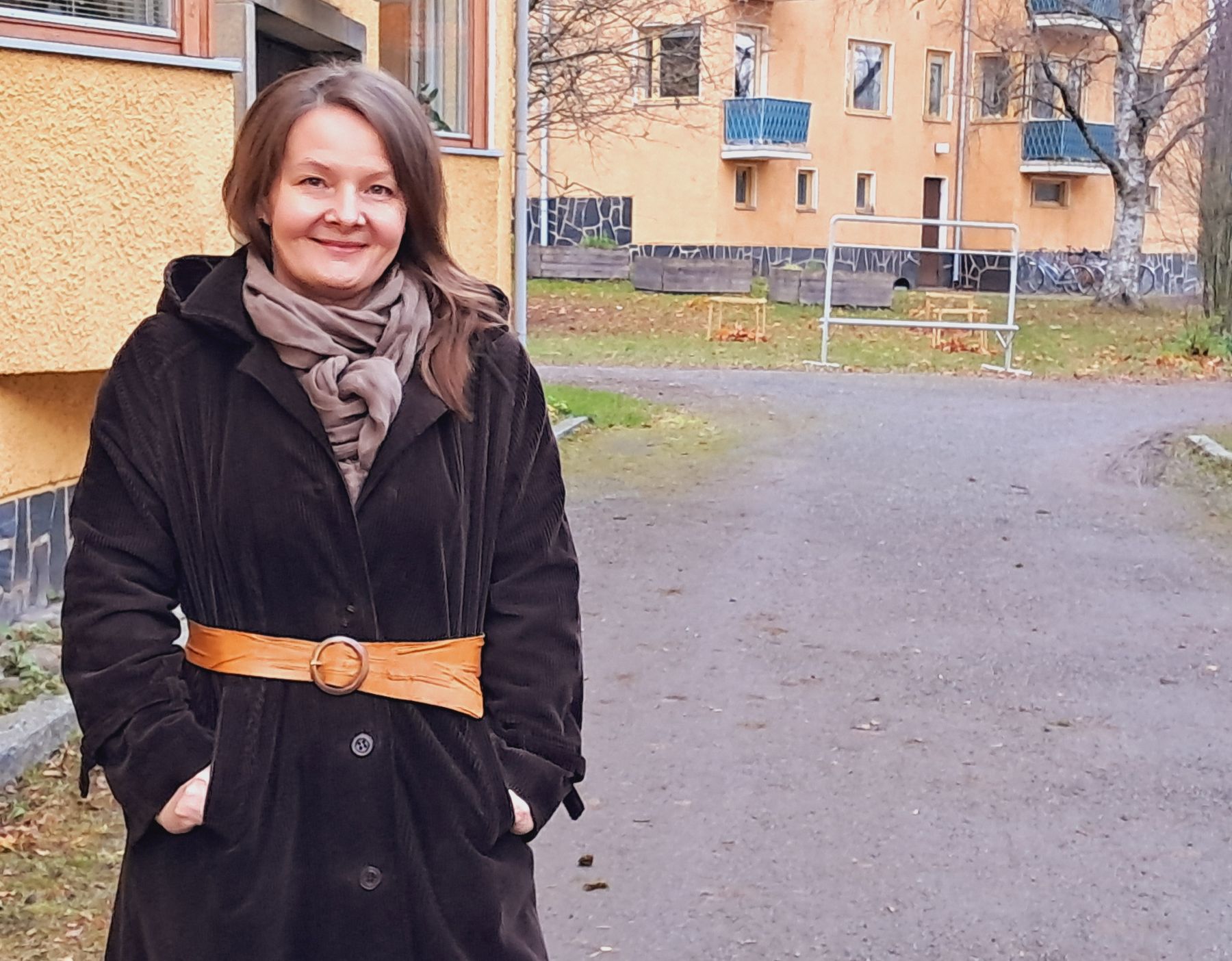
Photo: Kirsi Sandberg
Kirsi Sandberg tells us about her research, which explores the interface between sentence structure and text. One of the key datasets in her work has been the VoDe corpus, which contains the minutes of the plenary sessions of the Finnish Parliament covering more than 40 years.
I am Kirsi Sandberg, currently working as a grant-funded researcher in the Languages Unit at the Faculty of Information Technology and Communication Sciences, Tampere University. Before this, I worked as a researcher in the multidisciplinary consortium project Political Temporalities (POLTE), funded by the Research Council of Finland. The project explored how time is constructed in political discourse, examining narratives of continuity and change in the Finnish Parliament from 1976 to the present day.
Alongside my teaching and research work, I have been steadily advancing my doctoral dissertation in Finnish language studies. The monograph is now approaching its final stages.
My research is situated at the interface between sentence structure and text. I am interested in information structure, that is, how word choices, grammatical constructions, and word order in Finnish contribute to different discourse functions across a variety of texts.
In my doctoral research, I focus on the functions and thematic patterns of finite-verb-initial clauses as part of narrative, descriptive, and experience-based texts. In September, I joined the Kone Foundation–funded project Tunteiden Tampere (”Tampere in emotions”), which investigates affective language use. During the project, I will focus on linguistic affect and the ways it is constructed in different types of datasets.
One of the key datasets in the POLTE project was the Voices of Democracy (VoDe) corpus, which contains the minutes of the plenary sessions of the Finnish Parliament from 1980 to 2025. The corpus will soon be available via the Language Bank of Finland. The parliamentary records have been linguistically annotated using the TurkuNLP parser, allowing researchers to perform detailed searches based on lemmas, word co-occurrences, and morphological and syntactic features. As part of the project, we developed computational methods for studying parliamentary rhetoric, including narrative detection and the identification of future-oriented speech using both linguistic features and language models. Through these research processes, which included both qualitative and quantitative approaches, I became very familiar with parliamentary debates across four decades. More recently, with funding from the Niilo Helander Foundation, I examined the annual budget debates in the Finnish Parliament from a more linguistic perspective, focusing on information structure and discourse organisation
The Language Bank of Finland has played an important role in shaping my research path. Early in my doctoral studies, I took an introductory course on corpus linguistics offered by the Language Bank. It was there that I first discovered linguistically annotated datasets and began to understand their potential for linguistic research. Looking back, much of what I have described above can be traced back to that course.
Sandberg, K., Andrushchenko, M., & Hatavara, M. (2026). Operationalizing narrativized change in the political talk for computational recognition. Computational Humanities Research, 2. https://doi.org/10.1017/chr.2026.10029
Sandberg, K. (2025). Eduskunnan täysistuntopöytäkirjat, ajankohtainen parlamentaarisen kielen aineisto. Virittäjä, 129(4), 558–565. https://doi.org/10.23982/vir.176095
Hatavara, M., Sandberg, K., Andrushchenko, M., Hälikkö, S., Nummenmaa, J., Nummenmaa, T., Peltonen, J., & Hyvärinen, M. (2024). Computational recognition of narratives: Applying narratological definitions to the analysis of political language use. Narrative Inquiry, 34(2), 335–363. https://doi.org/10.1075/ni.22028.hat
Marjanen, J., Rautajoki H., Sandberg, K., Kurunmäki, J., Peltonen, J., and Nummenmaa, J. (Tulossa). From General to Spesific Futures: New Layers in Conceptualising the Future in the Finnish Parliament, 1980-2023. In Reading Parliaments in the Digital Age, edited by Hugo Bonin and Risto Turunen, Helsinki: Suomalaisen Kirjallisuuden Seura
Sandberg, K., Kuutsa, A., Jolma, N., Andrushchenko, M., Peltonen, J., Rautajoki, H., Nummenmaa, J., Hyvärinen, M.and Hatavara, M. (Tulossa). Narrating Agentive Experientiality in the Finnish Parliament from the 1980s until Today. In Reading Parliaments in the Digital Age, edited by Hugo Bonin and Risto Turunen, Helsinki: Suomalaisen Kirjallisuuden Seura
Sandberg, K., Andrushchenko, M., Turunen, R., Marjanen, J., Kurunmäki, J., Peltonen, J., Nummenmaa, T., & Nummenmaa, J. (2022). Analyzing Temporalities in Parliamentary Speech about Ideologies Using Dependency Parsed Data. In K. Berglund, M. La Mela, & I. Zwart (Eds.), Proceedings of the 6th Digital Humanities in the Nordic and Baltic Countries Conference (DHNB 2022) (pp. 406-414). (CEUR Workshop Proceedings; Vol. 3232). CEUR-WS. http://ceur-ws.org/Vol-3232/
The FIN-CLARIN consortium consists of a group of Finnish universities along with CSC – IT Center for Science and the Institute for the Languages of Finland (Kotus). FIN-CLARIN helps the researchers of Social Sciences and Humanities to use, refine, preserve and share their language resources. The Language Bank of Finland is the collection of services that provides the language materials and tools for the research community.
All previously published Language Bank researcher interviews are stored in the Researcher of the Month archive. This article is also published on the website of the Faculty of Humanities of the University of Helsinki.