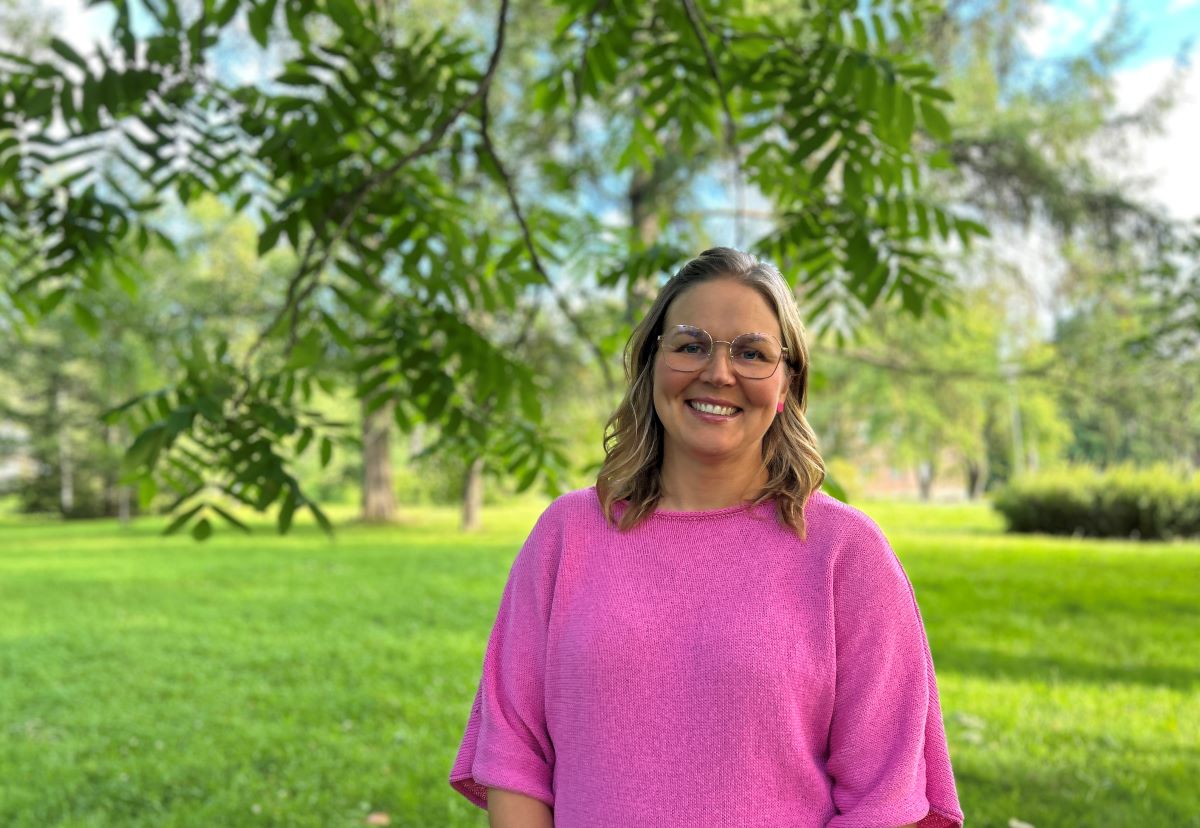
Photo: Marjo-Leea Alapuranen
Sanna Nordlund tells us about her research on Finnish Sign Language. Her work explores topics such as agent defocusing, the use of signing space, and referentiality. Annotated corpora provide valuable resources for investigating these phenomena and the linguistic structure of signs.
I am Sanna Nordlund, a doctoral researcher at the Sign Language Centre at the University of Jyväskylä. My research focuses on the structure of Finnish Sign Language from a corpus-based perspective. I am currently funded by a grant from the Finnish Cultural Foundation and have previously received a multi-year grant from the Kone Foundation. My previous experience includes serving as a substitute lecturer in the Sign Language Interpreter programme at Humak University of Applied Sciences (2023–2024) and working on the Corpus and SignWiki project at the Finnish Association of the Deaf (2013–2015). Prior to pursuing an academic career, I also worked as a sign language interpreter.
As a sign language researcher, I draw on and combine the knowledge and skills I acquired through my studies in general linguistics with the expertise I gained through my education and professional experience as a sign language interpreter. I also serve as one of the group leaders of the Sign Languages and Deaf Studies thematic group within the Langnet doctoral network.
In my doctoral research, I investigate agent defocufing, the use of signing space, and referentiality in Finnish Sign Language. In my first article, published in 2019, I examined the different ways in which the semantic role of agent can be defocused in Finnish Sign Language. The study identified several strategies for agent defocusing but found no evidence of a dedicated morphological passive.
My second article, published in the summer of 2026, analyzed the various functions of the pointing sign directed at the signer. Besides referring to the signer, such pointing serves a remarkably wide range of other functions. The manuscript of my third study is currently in preparation. In this work, I investigate how signing space and the signer’s body are used in the modification of so-called directional verbs.
My corpus-based research provides new evidence on structures that have received little or no previous scholarly attention and that have often been described primarily on the basis of intuition rather than language use. It also challenges and refines certain assumptions currently prevailing in sign language teaching.
The data for my doctoral research has gradually expanded alongside the development of corpus work on Finnish Sign Language. My first article (2019) is based on my Master’s thesis (Ala-Sippola 2012), completed at a time when a corpus of Finnish Sign Language was still only an aspiration. The study was based on approximately 11.5 minutes of signed material from the Finnish Sign Language version of the Language Policy Programme for the National Sign Languages in Finland. This material was later annotated and published in the Language Bank of Finland as the Kipo Corpus (2015). The Kipo Corpus was developed at the Finnish Association of the Deaf as part of the Corpus and SignWiki project, in which I worked between 2013 and 2015. During the project, we developed the first annotation conventions for Finnish Sign Language.
In my second article (2026), the data consists of the entire Kipo Corpus as well as three elicitation tasks from eight signers from the Corpus of Finnish Sign Language (CFINSL), published in 2019. The dataset includes recordings from 12 different signers and comprises a total of 4 hours and 55 minutes of video data. In my third article, I also use data from a corpus release published in 2024. In addition to the Kipo Corpus, the dataset includes CFINSL data from four elicitation tasks, bringing the total number of signers represented in the material to 28. To the best of my knowledge, this is the largest and most diverse corpus dataset used in research on Finnish Sign Language to date.
Although the detailed analyses are based on a corpus sample, the most frequent directional verbs were identified from all Finnish Sign Language corpus data that has been published in the Language Bank of Finland and annotated with ID glosses (CFINSL Parts 1 and 2 and the Kipo Corpus). The annotated corpus data amounts to approximately 26 hours. It is encouraging that research on Finnish Sign Language can increasingly rely on larger and more comprehensive datasets. Corpus data make it possible to identify linguistic features and phenomena that may remain unnoticed in studies based solely on language users’ intuitions.
Nordlund, Sanna. (2026). Uses of the pointing sign directed at the signer in Finnish Sign Language. Sign Language and Linguistics, Online First. https://doi.org/10.1075/sll.24009.nor.
Nordlund, S. (2019). Agent defocusing in two-participant clauses in Finnish Sign Language. Glossa: a journal of general linguistics 4(1), 82. http://doi.org/10.5334/gjgl.801
Ala-Sippola, Sanna. 2012. Agentin ilmaiseminen suomalaisella viittomakielellä tuotetussa asiatekstissä. Helsinki: Helsingin ylipisto, Pro gradu -tutkielma. [julkaisematon]
The FIN-CLARIN consortium consists of a group of Finnish universities along with CSC – IT Center for Science and the Institute for the Languages of Finland (Kotus). FIN-CLARIN helps the researchers of Social Sciences and Humanities to use, refine, preserve and share their language resources. The Language Bank of Finland is the collection of services that provides the language materials and tools for the research community.
All previously published Language Bank researcher interviews are stored in the Researcher of the Month archive. This article is also published on the website of the Faculty of Humanities of the University of Helsinki.