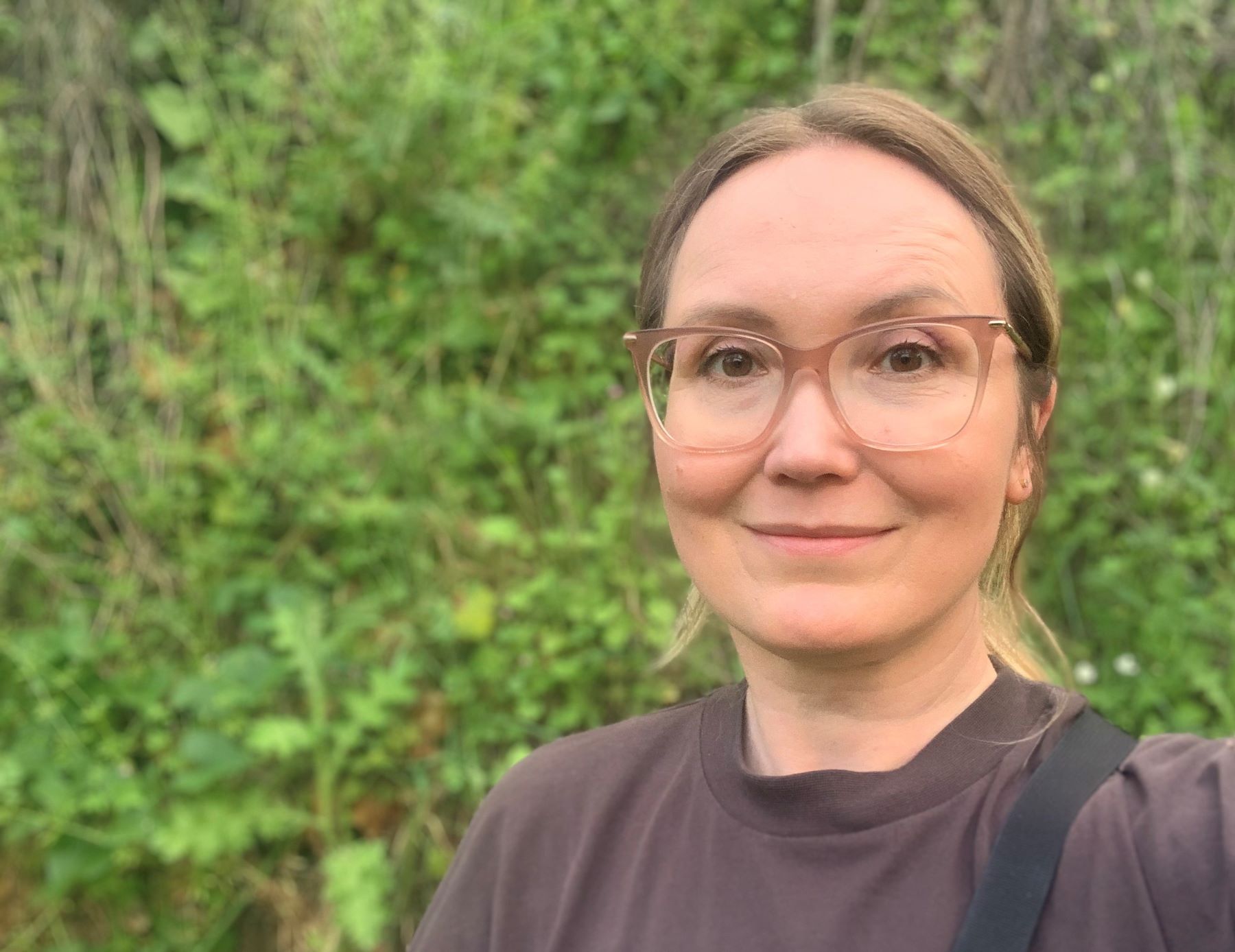
Photo: Mari Myllylä
Mari Myllylä tells us about her research on human thinking and cognitive errors. Factors related to erroneous thinking can be studied, for example, by identifying different types of argumentative fallacies, misinterpretations, and biases in online discussions.
I am Mari Myllylä, a cognitive scientist by training (PhD). I currently work as a postdoctoral researcher in the Business Finland–funded HiFive project at the Faculty of Information Technology, University of Jyväskylä. The project examines the experience of meaningfulness in industrial work that utilizes new technologies. Previously, I worked as a project researcher, for example in the ETAIROS project, where we examined ethical principles in the design of artificial intelligence.
The central focus of my research is human thinking and erroneous reasoning, as well as human–technology interaction and its design in various contexts. Currently, my research focuses in particular on developing design expertise and methods for intelligent technologies that are grounded in human thinking.
Human thinking guides all human activity. By studying the mental processes and contents associated with thinking, it is possible to explore, for instance, the kinds of conceptions, knowledge, and arguments people hold regarding climate change, factory work, or even urban art such as graffiti. This research helps us better understand differences in thinking between individuals. It also sheds light on how information is processed and the meanings underlying different types of activity.
Erroneous beliefs, as well as misinformation and disinformation about issues such as climate change, can spread widely through social media and influence the thinking of social groups. This creates a new kind of societal risk. However, while collecting data for my research in the ETAIROS project, I observed that several social media platforms strongly restrict access to their content.
To explore what and how people think and write about climate change in Finnish social media discourse, I was fortunately able to make use of the Suomi24.fi corpus, available through the Language Bank of Finland. I was particularly interested in the various forms of erroneous thinking reflected in the comments on this platform, such as fallacies in argumentation, misinterpretations, biases, misconceptions, claims based on false or insufficient information, and the mixing of knowledge and opinions.
Although Suomi24.fi represents only a very small portion of all social media writing in Finland, the analyzed discussions revealed several key factors related to erroneous thinking and climate change denial. Studying these phenomena would not have been possible without the data provided by the Language Bank.
Myllylä, M., & Saariluoma, P. (2026). Erroneous thinking on climate change. Journal of Environmental Planning and Management, 69(2), 528-545. https://doi.org/10.1080/09640568.2024.2389158
Myllylä, M., Cañas Delgado, J. J., & Saariluoma, P. (2023). On Conspiracy Thought Models in Thinking Climate Change. European Journal of Sustainable Development, 12(3), Article 15. https://doi.org/10.14207/ejsd.2023.v12n3p15
Myllylä, M., & Saariluoma, P. (2022, 50). Ilmastokeskustelun vaaralliset harhakäsitykset. Kanava, (5), 12-17.
The FIN-CLARIN consortium consists of a group of Finnish universities along with CSC – IT Center for Science and the Institute for the Languages of Finland (Kotus). FIN-CLARIN helps the researchers of Social Sciences and Humanities to use, refine, preserve and share their language resources. The Language Bank of Finland is the collection of services that provides the language materials and tools for the research community.
All previously published Language Bank researcher interviews are stored in the Researcher of the Month archive. This article is also published on the website of the Faculty of Humanities of the University of Helsinki.