Photo: Oona Rouvinen
Kielipankki – The Language Bank of Finland offers a comprehensive set of resources, tools and services in a high-performance environment. Krista Ojutkangas tells us about their corpus-based research on the Finnish language. Their work combines qualitative and quantitative observations, making both methodological perspectives relevant.
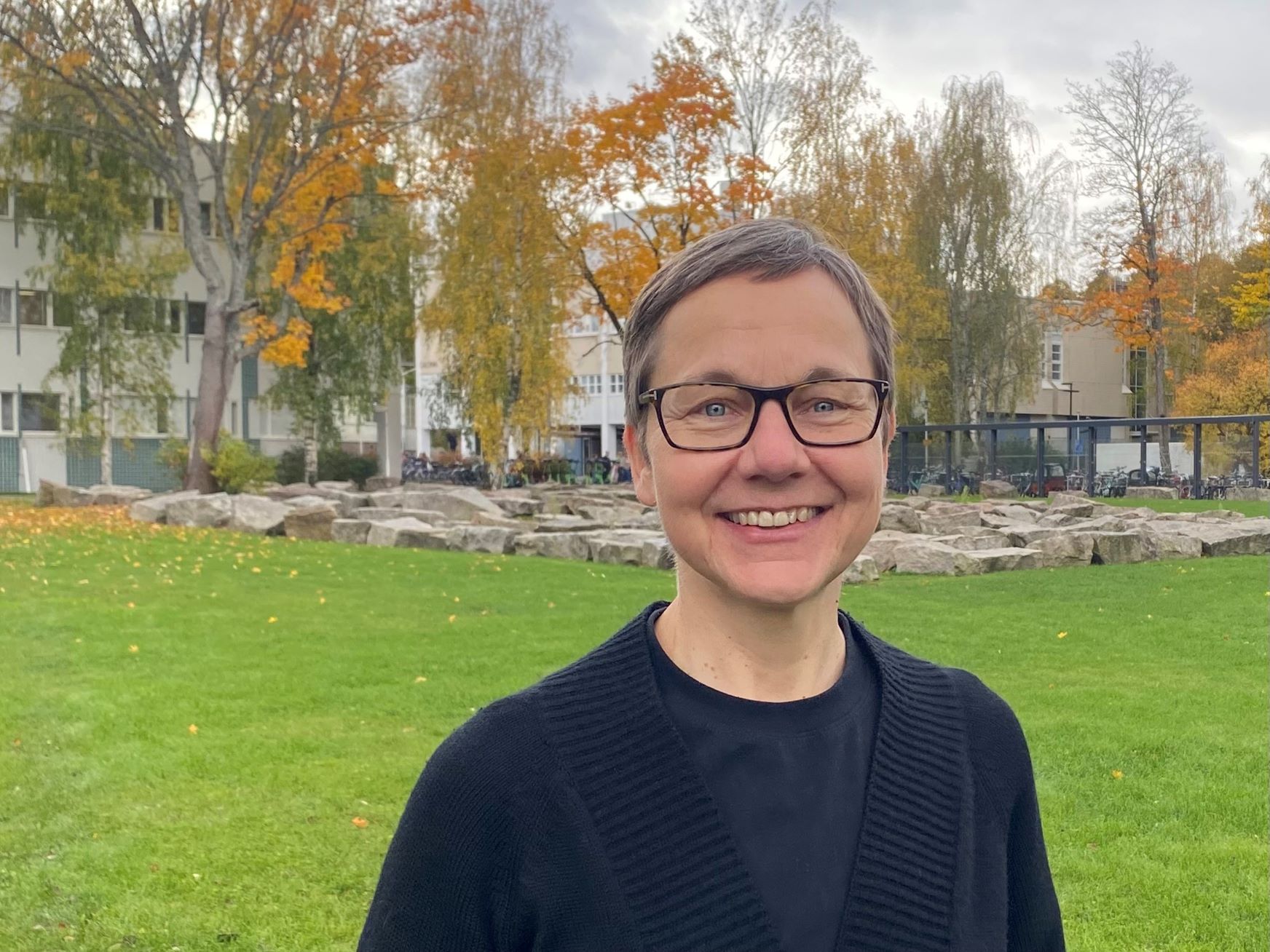
I am Krista Ojutkangas, Adjunct Professor and University Lecturer in Finnish language at the University of Turku. I conduct research in the project “Finnish relations: Changes in Finnish relational predicates from the 16th century to the present (FiRe)”, led by Tuomas Huumo and funded by the Research Council of Finland.
I am interested in grammar, especially the relationship between linguistic structures and semantics. In particular, I have studied spatial semantics, that is, how different locations are expressed in language, for example through local cases and postpositions. I am also interested in the diachronic development of these elements, which I have recently explored together with Minna Jaakola. Furthermore, I am interested in phenomena in Old Literary Finnish, such as word paratagmas or parallelism (cf. Finnish word combinations hyvä ja lysti ’good and funny’, juurtua ja itää ’root and sprout’, kuulla ja ymmärtää ’hear and understand’), which I have studied together with Kirsi-Maria Nummila. My latest research topic is transitivity, which I have investigated together with Ilmari Ivaska. This project began as an innocent plan for a single article, but preparations are already underway for seasons three and four.
I have always conducted corpus-based research in various ways, and I am also interested in the methods used in such research. I co-authored a chapter on qualitative corpus-based research together with Milla Luodonpää-Manni for a book on research methods in linguistics. In that chapter, I provide a very concrete account of my own research approach through illustrative case examples. I usually describe my research as qualitative, but in practice, qualitative and quantitative observations intertwine, and it is not meaningful to draw a strict line between methodological perspectives. In a study I conducted with Ilmari Ivaska, quantitative methods have taken center stage thanks to Ilmari’s expertise. Even in this collaboration, I always end up close-reading the data, and I’m persistent when it comes to tapping out a detailed analysis.
Of all the resources available through the Language Bank of Finland, the one closest to me is the Finnish Dialect Corpus of the Syntax Archive. As a bonus, it offers a glimpse into agrarian Finland of the last century. Most of its material is dialect interviews conducted in the 1960s, and almost all of the interviewees were born in the 19th century. Spoken data is also represented by the ArkiSyn Database of Finnish Conversational Discourse, but most of my research has focused on written language from different periods. I’ve made use of newspaper, journal, and news material through the Finnish Text Collection, the Newspaper and Periodical Corpus of the National Library of Finland (also in Swedish), and Yle Finnish News Archive.
The National Library’s collection of newspapers and periodicals reaches the 19th century, and I have gone deeper into history with the corpora of Old Literary Finnish and Early Modern Finnish. In our quantitative research on transitivity, we have also used the Suomi24 Sentences Corpus. However, given the range of topics and opinions it contains, it’s not a corpus I would necessarily choose for manual, close-reading analysis.
Browsing the resources in the Language Bank feels like stepping into a candy shop for a linguist like me. So many of the corpora are truly tempting and evoke curiosity and new research ideas. Even though I’m not a text researcher by definition, my methods make me appreciate having access to broader context in the data. A close reading of individual occurrences often benefits from seeing what comes before and after them in the text.
Ivaska, I., & Ojutkangas, K. (2025). Suomen transitiiviset verbit ja verbien transitiivisuus: kvantitatiivinen tutkimus. Virittäjä 129(1), 4–30. https://doi.org/10.23982/vir.146123
Jaakola, M. & Ojutkangas, K. (2023). Readymade grammar: Why are Finnish postpositions an open class? In M. Jaakola and T. Onikki-Rantajääskö (eds.), The Finnish Case System: Cognitive Linguistic Perspectives, 325–354. Helsinki: Suomalaisen Kirjallisuuden Seura. https://doi.org/10.21435/sflin.23
Luodonpää-Manni, M. & Ojutkangas, K. (2020). Laadullinen aineistopohjainen kielentutkimus. In M. Luodonpää-Manni, M. Hamunen, R. Konstenius, M. Miestamo, U. Nikanne and K. Sinnemäki (eds.) Kielentutkimuksen menetelmiä I–IV, 412–441. Helsinki: Suomalaisen Kirjallisuuden Seura. https://doi.org/10.21435/skst.1457
Nummila, K.-M., & Ojutkangas, K. (2013). Pyytämättä ja yllätyksenä. Paratagmakonstruktiot 1500–1800‐luvun kirjasuomessa. Sananjalka 55, 73–99. https://doi.org/10.30673/sja.86722
Ojutkangas, K. (2017). Suomen mukana ja mukaan seuralaisuussuhteen ilmaisijoina: kiintopisteen ilmaisukeinot, konstruktiot ja osallistujien symmetriaero. Virittäjä 121(2), 176–212. https://doi.org/10.23982/vir.58707
Ojutkangas, K. (2023). Dynamic local cases in use. Expressing directional events in Finnish. In M. Jaakola and T. Onikki-Rantajääskö (eds.), The Finnish Case System: Cognitive Linguistic Perspectives, 299–324. Helsinki: Suomalaisen Kirjallisuuden Seura. https://doi.org/10.21435/sflin.23
The FIN-CLARIN consortium consists of a group of Finnish universities along with CSC – IT Center for Science and the Institute for the Languages of Finland (Kotus). FIN-CLARIN helps the researchers of Social Sciences and Humanities to use, refine, preserve and share their language resources. The Language Bank of Finland is the collection of services that provides the language materials and tools for the research community.
All previously published Language Bank researcher interviews are stored in the Researcher of the Month archive. This article is also published on the website of the Faculty of Arts of the University of Helsinki.