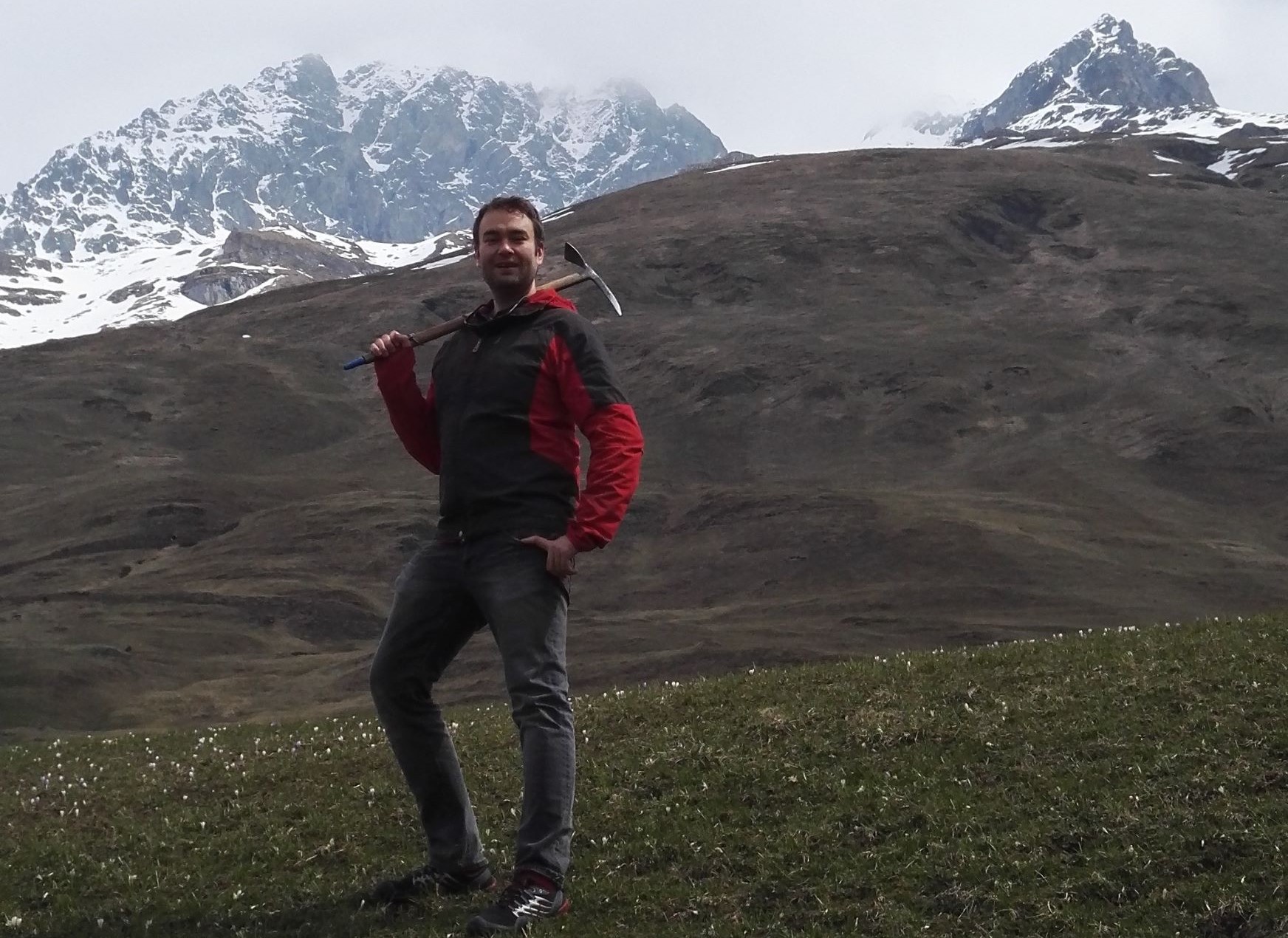
Photo: Thomas Bürgisser
Max Wahlström tells us about his research on the Suomi24 corpus. Because of its large size, the corpus enables the analysis of many different phenomena, but it also calls for caution in interpreting what the language represented in the data can tell us.
I am a Slavist and a linguist. Through my research, the region I know best is the Balkans. I am a senior university lecturer in the Faculty of Humanities at the University of Helsinki, where I teach Bosnian, Croatian, Montenegrin and Serbian, as well as a wide range of courses, mainly in linguistics and Slavic studies.
My research spans a wide range of topics, which can make it difficult to define a single unifying theme. When funding applications require one, I usually describe my interests as focusing on phenomena related to argument marking, referentiality and information structure, as well as their variation and diffusion through language contact. What fascinates me about language as an object of study is its emergence from human activity and interaction, and the regularities that arise from this process – regularities that speakers are often unaware of unless the rules are broken. It is precisely when rules are bent or stretched that particularly interesting phenomena emerge. When a new construction gains ground, a loanword spreads, or an expression becomes metaphorical, language appears at its most intriguing: a constantly changing and adaptive object.
The resources of the Language Bank allow me to study phenomena that are either too rare to be observed in smaller datasets or whose variation is shaped by complex factors such as linguistic context, genre or historical period. Because of its size, I have primarily used the Suomi24 corpus. Without it, the phenomena analysed in my article on social media “likes” could not have been investigated. At the same time, there are no free lunches: together with my colleagues, I examine the conditions under which Suomi24 can be considered a corpus in the same sense as many other resources in the Language Bank. Our work also shows that the topic of discussion has a major impact on how colloquial or standard the language in Suomi24 discussions is.
Niva, Heidi, Olli O. Silvennoinen & Max Wahlström. 2025. Mitä tutkimme, kun käytämme Suomi24-korpusta? Verkkokeskustelukorpus suomen edustajana. Virittäjä 129(4). 487–517. https://doi.org/10.23982/vir.163133.
Wahlström, Max. 2025. The “like” button and Finnish transitivity. Finnish Journal of Linguistics 38. 211–222. https://doi.org/10.61197/fjl.145021.
Makartsev, Maxim, Max Wahlström & Anastasia Escher. 2024. Lability in Balkan Slavic. Studies in Language. 1–28. https://doi.org/10.1075/sl.23062.mak.
Gijn, Rik van & Max Wahlström. 2023. Linguistic areas. Teoksessa Rik van Gijn, Hanna Ruch, Max Wahlström & Anja Hasse (eds.), Language contact: Bridging the gap between individual interactions and areal patterns, 179–219. Berlin: Language Science Press. https://doi.org/10.5281/zenodo.8269244.
Wahlström, Max & Jouko Sakari Lindstedt. 2020. Kielikontaktien tutkimus. Teoksessa Milla Luodonpää-Manni, Markus Hamunen, Reetta Konstenius, Matti Miestamo, Urpo Nikanne & Kaius Sinnemäki (eds.), Kielentutkimuksen menetelmiä I-IV (Suomalaisen Kirjallisuuden Seuran Toimituksia), 557–595. Helsinki: Suomalaisen Kirjallisuuden Seura. https://doi.org/10.21435/skst.1457.
The FIN-CLARIN consortium consists of a group of Finnish universities along with CSC – IT Center for Science and the Institute for the Languages of Finland (Kotus). FIN-CLARIN helps the researchers of Social Sciences and Humanities to use, refine, preserve and share their language resources. The Language Bank of Finland is the collection of services that provides the language materials and tools for the research community.
All previously published Language Bank researcher interviews are stored in the Researcher of the Month archive. This article is also published on the website of the Faculty of Humanities of the University of Helsinki.